“You are always making trouble for us. I have taken your picture and I am going to give it to the Haitian police. They will get you.”
- Brazilian officer speaking to journalist and film-maker Kevin Pina in Haiti
Kevin Pina previewed footage from his upcoming movie “Haiti: Betrayal of Democracy” in Washington D.C. on July 25th, days after another arrest of a well-respected supporter of the deposed president of Haiti Jean Bertrand Aristide and his Lavalas Movement. With congresswoman Maxine Waters in attendance, Pina dedicated the showing to the freedom and vision of Fr. Jean-Juste, who sits in a Haitian jail without written charges as what Amnesty International calls a “Prisoner of Conscience.”
Many people have already seen still shots from Pina’s movie without even realizing it. He has become the front man for a group of (anonymous) Haitian journalists, the Haiti Information Project, which has put the mainstream media to shame. The group consistently scoops stories about governmental violence against Haiti´s poor and takes photographic evidence that contradicts the assumptions and conclusions of international media about the daily reality of post-coup Haiti. Almost all of the recent photos of pro-democracy protests as well as the pictures of casualties caused by the Haitian police or the UN come from HIP. Months prior to the film showing this work manage to show up on the BBC when HIP showed Haitian police planting guns on the bodies of murdered Lavalas protesters. Such footage is often disturbingly graphic, which Pina warned the crowd as the lights in the Plymouth Congregational churched dimmed. But as the filmmaker added, “it is important for everyone to see this footage to understand what is really going on in Haiti.”
What is going on in Haiti?
From the film’s opening scene that shows U.S. Marines blocking the path of pro-democracy Haitian protesters in the wake of Aristide’s “kidnapping” by U.S. forces, the documentary paints a picture of internationally sanctioned campaign of violent repression against the poor communities of Haiti in general and Aristide’s Lavalas movement in particular.
“Betrayal of Democracy” is Pina’s second film on Haiti after “Harvest of Hope.” This sophomore effort exposes the role of United Nation’s forces in the current campaign of political violence in Haiti. With footage starting from January 2005, Pina documents aggression by the UN on behalf or in coordination with the Haitian Police.
The fact that the Haitian police are murdering political dissidents is not news in Haiti. As human rights investigators have proven, many of the coup leaders from the former military that have been responsible for numerous coups against the elected leaders of Haiti have been reincorporated into the police force. The resulting violence including indiscriminate shooting during raids in poor neighborhoods, arrests without charges, and outright assassinations is a pattern that has been repeated today from the coups of the past generation.
“Betrayal” surprises its audiences by showing how the deeply the UN first became complacent and then participatory in this pattern of violence. One resident of Cite Soleil commented that the UN is doing nothing serious in Haiti “except to massacre all those in favor of Aristide’s return.” With a series of interviews and graphic photographs from the aftermath of police and UN actions, the movie describes how the role of UN troops in HNP lead violence has continuously escalated.
On one occasion described in the film, it becomes clear that journalists from the HNP were preventing a massacre by filming masked Haitian police in black SUVs who had their guns drawn on the crowd. Since most pro-democracy demonstrations in Haiti include police assassinations, the crowd anticipated the type of killing seen during the anniversary of the Haitian coup on Februar 28th , but Pina and other photographers caused the police to hesitate because of the presence of international journalists. The Brazilian officer in charge UN forces on the scene responded to Pina by screaming “F*ck you!” repeatedly and telling him to “Go F*ck himself.” The Brazilian general then took Pina´s picture and threatened to pass the photo on to the Haitian Police so they could “take care of him.” Though the masked police withdrew from that confrontation, the movie then shows the footage from later that day on another street corner of the bodies of protesters lying on the ground, reportedly killed by police in black SUVs.
As this interaction shows, the UN has come to support the Haitian police unquestionably. In this case they threatened to help the police identify and target a pro-democracy activists, but the heart of the film shows repeated evidence of UN raids into poor neighborhoods like Cite Soleil that end in unwarranted arrests, destroyed houses, and indiscriminate firing on civilians.
The most graphic and shocking evidence of UN violence against the Haitian people came from the Cite Soleil on July 6. Scene after scene of that time shows Haitian men, women and children in their houses, in their beds or in the streets with gaping head wounds. While the UN for a long time claimed that they “knew of no civilian casualties” from this operation, the Haiti Information Project managed to confirm at least 20 deaths, almost all from head shots at relatively close range.
Pina underlined the fact that “the UN brought no medics to support this operation because they were not anticipating any injured civilians. They were shooting to kill. These were all headshots.” While the idea that the UN “peacekeeping” forces were assassinating civilians in Haiti´s poorest neighborhood to support the coup is difficult to accept, the footage is incontrovertible.
When seen with Pina´s first film on Haiti “Harvest of Hope,” the new “Betrayal” is even more sad because of how much history has repeated itself, and how little most people are aware of that fact. “Harvest of Hope” focuses on the first coup against president Aristide in 1991 when Aristide is arrested by the military, and bodies appear in the mourgue of Lavalas activists. That film reports 4000 killings, 250,000 people in hiding, and 43,000 boat refugees because of the 1991 coup. Indeed, the film goes back to the elections of 1987 to show that the military created panic and chaos in Haiti to disrupt the democratic process and maintain their hold on power. In all of this political violence, then as now, the hardest hit area is Cite Soleil, one of Lavalas´ strongest bases of support. Most of this political instability was lead by Haitian military figures on the CIA payroll, just as the current political situation was brought about by some of the same Haitian military figures with the help of the US marines.
Who are the UN force
The Haitian citizens repeatedly complain in the film that the Jordanian forces are the most violent and brutal, and complain that an army of a dictatorship should not have forces in the country supposedly to bring about democracy. But the UN led violence brings up questions about the other forces in the country, including Argentine, Chilean, and Brazilian forces. Pina took questions about this point, answering that “all of these militaries have sordid histories within their own countries,” referring to the military juntas that ruled these countries about a generation ago. But why would the “progressive” government of Lula in Brazil support this killing? Pina answered with two possibilities “Lula is trying to get Brazil a permenant seat on the UN security council among other strategic concerns, and he hopes that his soldiers’ role in Haiti will mollify American objections to that position,” adding that there is also an advantage to Lula of getting a troublesome military out of Brazil so it can do no harm there.
For whatever reason, the United Nation`s force in Haiti continues to act as an accomplice in the murder of Lavalas basis of support before the upcoming elections planned for the end of the year. Such elections, like the UN “peace-keeping force” only serve as political cover for theft of Haitian democracy.
The importance of the HIP
What Pina´s two movies, along with theShows the bankruptcy of current journalism out of Port Au Prince. While most individuals interpret Haiti’s current situation as somehow inherent in the Haitian people, and major media outlets continue to blame the violence in Haiti on “The Shadow of Aristide,” the Haiti Information Project continues to show graphic evidence of a widespread campaign of violence to restore to power the Haitian ruling class after the people voted them out of power. Taken in combination with previous works, “Betrayal” and the HIP give a historical context to today’s events, showing how the military players killing to stay in power and those in neighborhoods like Cite Soleil fighting for their democracy and survival have been locked in this battle since before the first democratic election went forward and was then overthrown,As such powerful testimony, HIP’s work has the ability to shock and inspire pro-democracy forces around the world to stand with the Haitian people to demand truth, justice and democracy. As one Lebanese-American activist said after seeing “Betrayal” in D.C . and trying to explain its importance to his colleagues “this is extremely important. Haiti is much worse than even Palestine.”
In short the work of HIP on http://www.haitiaction.net and in Pina’s films threaten to ignite the type of concentrated and long-term Haiti solidarity movement, if enough activists take the initiative to force these images and stories on the public conscience. (Truth in advertising, I have done voluntary translations of HIP stories into Spanish for dissemination in Latin America).
Sunday, August 21, 2005


Thursday, August 11, 2005
He estado muy ocupado. De hecho, ahorita estoy en Chiapas, y no tengo mucho tiempo para trabajar en el internet, aunque tengo tanto que quisiera decir. En los días siguientes, tendré mas para escribir. Abajo usted puede leer mi "personal statement" que entregué como parte de mi solicitude de estudiar medicina.
Disfrutalo.
========================
I want to be a physician with a Masters degree in public health because it will enable me to contribute to the health and well-being of the refugees of war, famine and violence through organizations like Medecins Sans Frontieres. In places of profound instability such as the slums of Mogadishu, the generations-old Palestinian refugee camps in Gaza or Lebanon, and the deserts of Darfur, vulnerable people can become desperate. With a dual clinical and community health background I can both offer the care and support that every human being deserves, and I can collaborate on community health projects in the affected communities. Thus, rather than allow such people to become disillusioned, I can use my training to respect and engage the intrinsic value of the world's poorest citizens.
This world is an unhealthy and dangerous medium for the growth of many of its inhabitants, and I hope to help reverse the trends that perpetuate this unfortunate situation. There are, of course, many root causes of global problems such as environmental devastation, political instability and epidemic disease. Furthermore, each locale has its own epidemics and environmental dangers. For example, Baltimore, the city I was raised in, suffers from excessive addiction rates and pervasive violence that threaten entire communities on a daily basis.Since the causes of suffering are numerous, I could approach these problems from many distinct perspectives. However, since many of these problems are rooted in unhealthy and fractured communities, I intend to help heal communities with knowledge of clinical medicine and an informed background in public health.
While I am convinced of the nobility and necessity of such projects, I do not intend to become a medical nomad wandering the world and treating the sick. I have deep respect for individuals like Paul Farmer that work full time on health projects in endangered communities such as the AIDS patients of Haiti. Nevertheless, I will probably only do such work on temporary basis, eventually returning to my home community.
On the other hand, I am no less concerned about the security, health and harmony of communities that are not in such a dramatic stage of social breakdown. Poor and wealthy communities alike suffer from dangers as disparate as cancer and handgun violence that necessitate both individual medical treatment and community-wide knowledge and action.
For example, the citizens of the Wagner's Point neighborhoods in Baltimore City complained for years about their isolation from the rest of the city by several large chemical plants. These plants had a history of dangerous accidents and the only road out of the neighborhood went between two such chemical manufacturing facilities. The community organized itself and, with the help of public health professionals, articulated its concern that a strategically unfortunate chemical spill could trap and poison residents. The city finally bought out the neighbors after a dramatic chemical leak highlighted this real and present danger. While this may not have been exactly the resolution that the community wanted, my mother's role as an physician with a master's degree in public health was important in allowing the neighborhood's concerns to be taken seriously.
It is exactly this type of work that I hope to combine with the classical, clinical role of a physician. I am convinced that the best way to keep a community safe is not only to have enough doctors to treat all the possible chemical burns, but to use public health experience preventatively and in collaboration with the residents to allow them to provide for their own health and well-being.
That being said, I know my role as a clinical physician will bring me into close contact with the communities I treat. I intend to live in the neighborhoods of my patients if possible and encourage values of collective well-being as I care for individuals' well-being. Furthermore, it is in the separation of the poor and the rich and the segregation by race and religion that other profound fractures in society become institutionalized. I hope that in addition to simply treating individuals from all backgrounds, I can help build a community between them and overcome societal divisions that underlie many societal faults. These fault lines are often the basis of societal instability, violence, and ill will.
In my time abroad I have met and spoken with Argentine textile workers, Salvadoran-American housekeepers, Mexican peasant farmers and all measures of Cuban society. Getting to know such people was occasionally awkward for a relatively wealthy North American student like myself. Nevertheless, with a common language, a little bit of shared context, and some effort I got to know many of them as equals and build some form of communal bonds with them.
In some ways, I want to be a doctor in order to become wealthy. However, I define wealth by the strength and support of my community, and in this way I want to create such wealth for myself and my community.
Disfrutalo.
========================
I want to be a physician with a Masters degree in public health because it will enable me to contribute to the health and well-being of the refugees of war, famine and violence through organizations like Medecins Sans Frontieres. In places of profound instability such as the slums of Mogadishu, the generations-old Palestinian refugee camps in Gaza or Lebanon, and the deserts of Darfur, vulnerable people can become desperate. With a dual clinical and community health background I can both offer the care and support that every human being deserves, and I can collaborate on community health projects in the affected communities. Thus, rather than allow such people to become disillusioned, I can use my training to respect and engage the intrinsic value of the world's poorest citizens.
This world is an unhealthy and dangerous medium for the growth of many of its inhabitants, and I hope to help reverse the trends that perpetuate this unfortunate situation. There are, of course, many root causes of global problems such as environmental devastation, political instability and epidemic disease. Furthermore, each locale has its own epidemics and environmental dangers. For example, Baltimore, the city I was raised in, suffers from excessive addiction rates and pervasive violence that threaten entire communities on a daily basis.Since the causes of suffering are numerous, I could approach these problems from many distinct perspectives. However, since many of these problems are rooted in unhealthy and fractured communities, I intend to help heal communities with knowledge of clinical medicine and an informed background in public health.
While I am convinced of the nobility and necessity of such projects, I do not intend to become a medical nomad wandering the world and treating the sick. I have deep respect for individuals like Paul Farmer that work full time on health projects in endangered communities such as the AIDS patients of Haiti. Nevertheless, I will probably only do such work on temporary basis, eventually returning to my home community.
On the other hand, I am no less concerned about the security, health and harmony of communities that are not in such a dramatic stage of social breakdown. Poor and wealthy communities alike suffer from dangers as disparate as cancer and handgun violence that necessitate both individual medical treatment and community-wide knowledge and action.
For example, the citizens of the Wagner's Point neighborhoods in Baltimore City complained for years about their isolation from the rest of the city by several large chemical plants. These plants had a history of dangerous accidents and the only road out of the neighborhood went between two such chemical manufacturing facilities. The community organized itself and, with the help of public health professionals, articulated its concern that a strategically unfortunate chemical spill could trap and poison residents. The city finally bought out the neighbors after a dramatic chemical leak highlighted this real and present danger. While this may not have been exactly the resolution that the community wanted, my mother's role as an physician with a master's degree in public health was important in allowing the neighborhood's concerns to be taken seriously.
It is exactly this type of work that I hope to combine with the classical, clinical role of a physician. I am convinced that the best way to keep a community safe is not only to have enough doctors to treat all the possible chemical burns, but to use public health experience preventatively and in collaboration with the residents to allow them to provide for their own health and well-being.
That being said, I know my role as a clinical physician will bring me into close contact with the communities I treat. I intend to live in the neighborhoods of my patients if possible and encourage values of collective well-being as I care for individuals' well-being. Furthermore, it is in the separation of the poor and the rich and the segregation by race and religion that other profound fractures in society become institutionalized. I hope that in addition to simply treating individuals from all backgrounds, I can help build a community between them and overcome societal divisions that underlie many societal faults. These fault lines are often the basis of societal instability, violence, and ill will.
In my time abroad I have met and spoken with Argentine textile workers, Salvadoran-American housekeepers, Mexican peasant farmers and all measures of Cuban society. Getting to know such people was occasionally awkward for a relatively wealthy North American student like myself. Nevertheless, with a common language, a little bit of shared context, and some effort I got to know many of them as equals and build some form of communal bonds with them.
In some ways, I want to be a doctor in order to become wealthy. However, I define wealth by the strength and support of my community, and in this way I want to create such wealth for myself and my community.
Sunday, July 24, 2005
Brazilian unconnected to bombings shot by London Police
In Charles Todd's blog yesterday, he argued that the extra-judicial killing of a man in the London tubes reflected very poorly on the London police in particular and on the Western anti-terrorism tactis in general.
Well, it turns out the "suspect" was a Brazilian electrician "unconnected" with those bombings. Just another reason to oppose the death penalty in all of its manifestations.
Well, it turns out the "suspect" was a Brazilian electrician "unconnected" with those bombings. Just another reason to oppose the death penalty in all of its manifestations.
Update from Bill Quiqley
I received the following update yesterday, but have been without power since last night. Below is an update on the beating and arbitrary arrest of a Haitian priest who has been active in the fight for democracy in Haiti.
------------
By Bill Quigley, professor of law at Loyola University
New Orleans School of Law.
A half an hour ago,over a dozen masked policeofficers with machine guns, forced a handcuffedFr.Jean-Juste into a police van and sped away.
As he was being put into the police wagon heyelled to the officers and the onlookers "Where is thejustice in Haiti? I am a priest. Why do you treatpeople like this? Vive Aristide!"
No one yet knows where Fr. jean-Juste has beentaken. No written charges have been made against him.
This afternoon Fr. jean-Juste was still in Petitionville jail, where he shared a single toilet with over 40 prisoners. There were no beds and norunning water.
He had a quick hearing with a justice of thepeace, who refused to wait until Mario Joseph, his Haitian lawyer could be present. No written chargeswere shared - again questions were like, what party doyou belong to? can you explain your presence at thefuneral of Jacques Roche? Do you know why the banditskilled him? Do you visit the poor neighborhood ofBel-Air frequently?
At the conclusion of the meeting with the justiceof the peace, we took a harrowing ride with policemachine guns downtown to the prosecutor's office whereno questions were asked and no conversation was held.Papers were signed and Fr. Jean-Juste was placed inhandcuffs and taken away.
Mario Joseph, of the Institute of Justice and Democracy in Haiti, and I will continue to try to findout where Fr. Jean-Juste is over the weekend and will report what we know. The only thing we know for certain is the answer to Fr. Jean-Juste's cry to the soldiers, "Where isjustice in Haiti?" If there is to be justice in Haiti, it rests with those who are willing to struggle
Freedom is coming, but only if we keep up the pressure.
------------
By Bill Quigley, professor of law at Loyola University
New Orleans School of Law.
A half an hour ago,over a dozen masked policeofficers with machine guns, forced a handcuffedFr.Jean-Juste into a police van and sped away.
As he was being put into the police wagon heyelled to the officers and the onlookers "Where is thejustice in Haiti? I am a priest. Why do you treatpeople like this? Vive Aristide!"
No one yet knows where Fr. jean-Juste has beentaken. No written charges have been made against him.
This afternoon Fr. jean-Juste was still in Petitionville jail, where he shared a single toilet with over 40 prisoners. There were no beds and norunning water.
He had a quick hearing with a justice of thepeace, who refused to wait until Mario Joseph, his Haitian lawyer could be present. No written chargeswere shared - again questions were like, what party doyou belong to? can you explain your presence at thefuneral of Jacques Roche? Do you know why the banditskilled him? Do you visit the poor neighborhood ofBel-Air frequently?
At the conclusion of the meeting with the justiceof the peace, we took a harrowing ride with policemachine guns downtown to the prosecutor's office whereno questions were asked and no conversation was held.Papers were signed and Fr. Jean-Juste was placed inhandcuffs and taken away.
Mario Joseph, of the Institute of Justice and Democracy in Haiti, and I will continue to try to findout where Fr. Jean-Juste is over the weekend and will report what we know. The only thing we know for certain is the answer to Fr. Jean-Juste's cry to the soldiers, "Where isjustice in Haiti?" If there is to be justice in Haiti, it rests with those who are willing to struggle
Freedom is coming, but only if we keep up the pressure.
Saturday, July 23, 2005
Haitian Priest Assaulted at Roche's Funeral and Arrested for Murder
It seems that the anti-Lavalas attack in response to the killing of journalist Jacques Roche has already begun. I just recieved this email below from Bill Quigley in Haiti. Apparently Roche was associated in some way with the "Group of 184" which was an organization of business people and "elites" that worked for the overthrow of Aristide and in support of the recent coup.
Since Roche's body was found in a poor neighborhood, it was assumed by much of the Haitian media that the Lavalas Party was behind the murder. Furthermore, there seems to have been an organized campaign against a Pro-Democracy priest Fr. Gerard Jean-Juste, who was a friend of the Roche family as well as an ally of Aristide. Jean-Juste is now in jail for the murder of Roche. The evidence that the state has is "public clamour" in the form of vociferous and baseless accusations against the priest at the funeral for the slain journalist.
Please read all the way to the end, and take the action steps suggested by Mr. Quigley, whose contact information is available to any inquiring journalists.
------------------
Haitian Priest Assaulted by Mob at Funeral andArrested for Murder.
By Bill Quigley, in Port au Prince. Bill is a lawprofessor at Loyola University New Orleans and is co-counsel with Mario Joseph and the Institute forJustice and Democracy in Haiti. Mario Joseph can be reached at (contact information available upon request).
On Thursday July 21, 2005, Fr. Gerard Jean-Justewent to St. Pierre's Catholic Church to be one of the priests participating in the funeral of Haitian journalist Jacques Roche. Fr. Jean-Juste is a cousin of the Roche family and members of the Roche family protected him from a mob earlier in his life. He went to express spiritual comfort and reconciliation to the family.
The tragic kidnapping and death of Jacques Rochehas been taken up as a cause by those opposed to the Lavalas party. Jacques Roche was identified as a supporter of the people calling themselves the group of 184, who overthrew by force the democratically elected goverment of President Aristide, the leader ofthe Lavalas party, in February 2004.
Oppononents of Aristide say that because the body of Jacques Roche was found in a poor neighborhood that he was executed by the Lavalas party who is very strong in the poorest neighborhoods. For those of us in the US, this is much like blaming John Kerry for inner city deaths because most of the people in the inner city vote democratic.
Fr. Jean-Juste went to the funeral expressly to pay his respects to the family and express his open remorse and opposition to any killing of anyone, no matter their political affiliation.
Jacques Roche's coffin was in the chapel next to the sacristy and main area of the chuch. At 10 o'clock the bishop and about seven priests robed in white with purple stoles or sashes paraded out of the sacristy of the church to the chapel next to the main area of the church to say blessings over the coffin of Jacques Roche.
When Fr. Jean-Juste walked out, people started yelling at him in the chapel. They called him"assasin" and "criminal" and yelled out to "arrest and kill the rat."
Fr. Jean-Juste has been publicly accused in the last several days of "a plot against the security ofthe state," smuggling money and guns into the country, and of being behind all the kidnappings. All clearly false charges but widely reported by unfriendly press.
People knew Fr. Jean-Juste was coming to the funeral because that was printed on the front page of a conservative paper the day before.
As the well-dressed people continued yelling at Fr. Jean-Juste, the prayer service nearly turned into a riot. The other priests turned to leave and a well-dressed crowd of screaming people surrounded him. I went out to be by his side. Some plain clothes security people and a few priests surrounded us and helped push us through the increasingly hostile crowd back into the church sacristy.
The other priests then persuaded Fr. Jean-Juste not to continue in the funeral service. So we stood aside as the priests and the funeral crowd filed pastus into the main church.
Well-dressed men and women continued to scream and threaten Fr. Gerry as they moved by us into the church. Then a crowd of 15 or 20 or more young men, not dressed at all for the funeral came into the sacristy and the mood turned uglier and more menacing. At that point, the security forces melted away.
The young men continued the screaming started by the well-dressed people and then started pushing and hitting Pere Jean-Juste. At that point a young woman came out of the funeral crowd and embraced Fr. Jean-Juste shielding him with her body from the blows and the increasingly loud and angry young men. She started praying loudly and saying "mon pere, mon pere."
A man in a suit, who identified himself as head of security for the funeral, rushed back in from the church area - only a few feet away and in plain view-and told Fr. Gerry these people were going to kill him there in the sacristy unless he fled. Fr. Jean-Juste knelt to pray and the woman and I knelt with him in the middle of the growing crowd.
At that point people started slapping Fr.Jean-Juste on the head and face and spitting on him and the other two of us. Something then hit Fr. Jean-Juste in the head. Someone punched him in the eye. We stood up and a few UN CIVPOL officers showed up to help us leave the sacristy of the church. As we tried to get to the stairs people continued pushing and screaming and shouting threats. They continued to call out "assasin," "criminal," and "kill the rat." The crowd now overwhelmed the police. More people spit on us and hit Fr. Gerry, even in the face, while others were grabbing his church vestments trying to drag him off the church steps.
The CIVPOL were trying to hold back the crowd but were still well outnumbered and were not able to halt the mob. We moved up the steps into a narrow dark corridor while the crowd pushed and shoved and spit and hit. We then retreated into a smaller corridor and finally to a dead end that contained two small concrete toilet stalls.
The three of us were pushed into the stalls as the crowd banged on the walls and doors of the stalls and continued screaming. The woman held the door closed and prayed loudly as the people outside roared and the CIVPOL called for reinforcements.
After a few minutes, reinforcements arrived andthe hallway was finally cleared of all but us and the authorities.
A man in a suit identifying himself as secretary for security for Haiti told us that he was going to have to arrest Fr. Jean-Juste because public clamor had identified him as the assasin of journalist Jacques Roche. The police would bring him to the police station for his own safety. Fr. Jean-Juste told the man that he was in Florida when thejournalist was killed and he wanted to return to St.Claire's, his parish. The man left escorting out the woman who helped us.
In a few minutes, CIVPOL police, including troopsfrom Jordan, surrounded Fr. Jean-Juste and I and ran us out of the church to a police truck. The truck with police with machine guns sped away from the church and took us not to Fr. Gerry's parish but to the police station in Petitionville.
For the next seven or eight hours we were kept in aroom while the UN forces and the Haitian forces negotiated about what to do. Fr. Gerry read his prayer book while we waited. We were told informally that the UN wanted to escort Fr. Jean-Juste back tohis parish but the Haitian government was insisting that he be arrested.
The attackers were allowed to go free and not arrested, but they wanted to arrest the victim!
Fr. Gerry told me "This is all a part of the death sentence called down upon me on the radio in Miami. The searches at the airport, the visits to the police stations, the mandate to appear before a criminal judge yesterday, and now this. It is all part of the effort to silence my voice for democracy."
At about 6pm, several Haitian officers came intoour room and ordered Fr. Gerry and I and Haitian attorney Mario Joseph to come with them.
The officers held out a piece of paper that they said was an official complaint against Fr. Gerry accusing him of being the assasin of Jacques Roche. The complaint was based on "public clamor" at the funeral identifying him as the murderer. They refused to let Fr. Jean-Juste or the lawyers see this paper. It was their obligation, they said, to investigate this public clamor identifying him as the murderer. If Fr. Jean-Juste chose not to talk with them, they would put him in jail immediately.
Fr. Jean-Juste agreed to the interrogation and it went on for over three hours. He was growing increasingly sore and tired from the beating he took, but was not bleeding externally. When the lawyers argued with the police, Fr. Gerry read his prayerbook.
The police already knew that Fr. Jean-Juste was in Florida at the time of the kidnapping and death of the journalist, because the police had already interviewed him several times in the last few days in connectionwith the other false allegations against him, but asked him many questions anyway. How many cell phones did he have? What is his exact relation to Jacques Roche? Why did he go to the funeral? Can he prove hewas in Florida? Since he was on the news in Florida can he provide a copy of the newstape showing he was in Florida? When Aristide was president was he provided with armed security? What happened to the pistols that his secutity had? Could he find out and have any pistols returned to the government? Why did he go to the funeral? Did Lavalas promise Aristide to execute someone from the group of 184 in retaliation for them taking power? When was the last time he was in the US? Are the Catholic sisters in Bel-Air with you when you got to demonstrations there? and on and on.
After over three hours, the interrogation finished.
With great solemnity the police told Fr. Jean-Justethat he was being charged with participating in the death of Jacques Roche and not returning state property. The said the law orders that he will be brought before a judge within 48 hours for further decision.
At exactly 10pm, Fr. Gerry handed me his keys and church vestments and was locked into the jail cell at Petionville with many, many others. He was holding a pink plastic rosary, his prayer book and a roll of toilet paper.
He flashed a tired smile and told me: "Now you see what we are up against in Haiti. If they treat me like this, think how they treat the poor people. Tell everyone that with the help of God and everyone else I will keep up the good fight. Everyone else should continue to fight for democracy as well. The truth will come out. I am innocent of all charges. I will be free soon. Freedom for Haiti is coming. The struggle continues."
As I left him, a very tired Fr. Gerard Jean-Justewas being greeted by all the prisoners in the very crowded jail cell as "mon pere!"
Action: Write or fax UN Special Representative, Juan Gabriel Valdés, urging him to release MINUSTAH'sprison report immediately, and to resist pressure from the Haitian police to minimize the number of casualties. A sample letter is below.
Mr. Valdés speaks English, French and Spanish.
His fax number is(dial 011 first from the US for an international line)509 244 3512.
__________
Mr Juan Gabriel Valdés Special Representative of the Secretary-General United Nations Stabilization Mission in Haiti
387, avenue John Brown
Port-au-Prince, Haiti
__________
Contact Information:U.S. Ambassador to Haiti, James B. FoleyUnited States Embassy
Port-au-Prince, HaitiTelephones: 011-509-223-4711, or 222-0200 or 0354
Fax: 011-509-223-1641 or 9038Email to Dana Banks, Human Rights Officer:
BanksD@state.gov
___________
Canadian Ambassador to Haiti,
Claude BoucherEmbassy of CanadaPort-au-Prince, Haiti
Telephone: 011-509- 249-9000Fax: 011-509-249-9920
Email: prnce@international.gc.ca
________________________________________________
Ambassador of France in Haiti, M. Yves GAUDEUL
Embassy of France
51 place des Héros de l'Indépendance - BP 312
Port-au-Prince, Haiti
Telephone: 011-509-222-0952
Fax : 011-509-223 5675
Haiti Authorities:
Fax. No. 011-509-245-0474
Me. Henri Dorléans
Ministre de la Justice et de la Securite Publique
Ministre de la Justice19
Avenue Charles SumnerPort-au-Prince, Haiti
_______________
blogger's note:
sample letter will be posted shortly(hopefully)
Since Roche's body was found in a poor neighborhood, it was assumed by much of the Haitian media that the Lavalas Party was behind the murder. Furthermore, there seems to have been an organized campaign against a Pro-Democracy priest Fr. Gerard Jean-Juste, who was a friend of the Roche family as well as an ally of Aristide. Jean-Juste is now in jail for the murder of Roche. The evidence that the state has is "public clamour" in the form of vociferous and baseless accusations against the priest at the funeral for the slain journalist.
Please read all the way to the end, and take the action steps suggested by Mr. Quigley, whose contact information is available to any inquiring journalists.
------------------
Haitian Priest Assaulted by Mob at Funeral andArrested for Murder.
By Bill Quigley, in Port au Prince. Bill is a lawprofessor at Loyola University New Orleans and is co-counsel with Mario Joseph and the Institute forJustice and Democracy in Haiti. Mario Joseph can be reached at (contact information available upon request).
On Thursday July 21, 2005, Fr. Gerard Jean-Justewent to St. Pierre's Catholic Church to be one of the priests participating in the funeral of Haitian journalist Jacques Roche. Fr. Jean-Juste is a cousin of the Roche family and members of the Roche family protected him from a mob earlier in his life. He went to express spiritual comfort and reconciliation to the family.
The tragic kidnapping and death of Jacques Rochehas been taken up as a cause by those opposed to the Lavalas party. Jacques Roche was identified as a supporter of the people calling themselves the group of 184, who overthrew by force the democratically elected goverment of President Aristide, the leader ofthe Lavalas party, in February 2004.
Oppononents of Aristide say that because the body of Jacques Roche was found in a poor neighborhood that he was executed by the Lavalas party who is very strong in the poorest neighborhoods. For those of us in the US, this is much like blaming John Kerry for inner city deaths because most of the people in the inner city vote democratic.
Fr. Jean-Juste went to the funeral expressly to pay his respects to the family and express his open remorse and opposition to any killing of anyone, no matter their political affiliation.
Jacques Roche's coffin was in the chapel next to the sacristy and main area of the chuch. At 10 o'clock the bishop and about seven priests robed in white with purple stoles or sashes paraded out of the sacristy of the church to the chapel next to the main area of the church to say blessings over the coffin of Jacques Roche.
When Fr. Jean-Juste walked out, people started yelling at him in the chapel. They called him"assasin" and "criminal" and yelled out to "arrest and kill the rat."
Fr. Jean-Juste has been publicly accused in the last several days of "a plot against the security ofthe state," smuggling money and guns into the country, and of being behind all the kidnappings. All clearly false charges but widely reported by unfriendly press.
People knew Fr. Jean-Juste was coming to the funeral because that was printed on the front page of a conservative paper the day before.
As the well-dressed people continued yelling at Fr. Jean-Juste, the prayer service nearly turned into a riot. The other priests turned to leave and a well-dressed crowd of screaming people surrounded him. I went out to be by his side. Some plain clothes security people and a few priests surrounded us and helped push us through the increasingly hostile crowd back into the church sacristy.
The other priests then persuaded Fr. Jean-Juste not to continue in the funeral service. So we stood aside as the priests and the funeral crowd filed pastus into the main church.
Well-dressed men and women continued to scream and threaten Fr. Gerry as they moved by us into the church. Then a crowd of 15 or 20 or more young men, not dressed at all for the funeral came into the sacristy and the mood turned uglier and more menacing. At that point, the security forces melted away.
The young men continued the screaming started by the well-dressed people and then started pushing and hitting Pere Jean-Juste. At that point a young woman came out of the funeral crowd and embraced Fr. Jean-Juste shielding him with her body from the blows and the increasingly loud and angry young men. She started praying loudly and saying "mon pere, mon pere."
A man in a suit, who identified himself as head of security for the funeral, rushed back in from the church area - only a few feet away and in plain view-and told Fr. Gerry these people were going to kill him there in the sacristy unless he fled. Fr. Jean-Juste knelt to pray and the woman and I knelt with him in the middle of the growing crowd.
At that point people started slapping Fr.Jean-Juste on the head and face and spitting on him and the other two of us. Something then hit Fr. Jean-Juste in the head. Someone punched him in the eye. We stood up and a few UN CIVPOL officers showed up to help us leave the sacristy of the church. As we tried to get to the stairs people continued pushing and screaming and shouting threats. They continued to call out "assasin," "criminal," and "kill the rat." The crowd now overwhelmed the police. More people spit on us and hit Fr. Gerry, even in the face, while others were grabbing his church vestments trying to drag him off the church steps.
The CIVPOL were trying to hold back the crowd but were still well outnumbered and were not able to halt the mob. We moved up the steps into a narrow dark corridor while the crowd pushed and shoved and spit and hit. We then retreated into a smaller corridor and finally to a dead end that contained two small concrete toilet stalls.
The three of us were pushed into the stalls as the crowd banged on the walls and doors of the stalls and continued screaming. The woman held the door closed and prayed loudly as the people outside roared and the CIVPOL called for reinforcements.
After a few minutes, reinforcements arrived andthe hallway was finally cleared of all but us and the authorities.
A man in a suit identifying himself as secretary for security for Haiti told us that he was going to have to arrest Fr. Jean-Juste because public clamor had identified him as the assasin of journalist Jacques Roche. The police would bring him to the police station for his own safety. Fr. Jean-Juste told the man that he was in Florida when thejournalist was killed and he wanted to return to St.Claire's, his parish. The man left escorting out the woman who helped us.
In a few minutes, CIVPOL police, including troopsfrom Jordan, surrounded Fr. Jean-Juste and I and ran us out of the church to a police truck. The truck with police with machine guns sped away from the church and took us not to Fr. Gerry's parish but to the police station in Petitionville.
For the next seven or eight hours we were kept in aroom while the UN forces and the Haitian forces negotiated about what to do. Fr. Gerry read his prayer book while we waited. We were told informally that the UN wanted to escort Fr. Jean-Juste back tohis parish but the Haitian government was insisting that he be arrested.
The attackers were allowed to go free and not arrested, but they wanted to arrest the victim!
Fr. Gerry told me "This is all a part of the death sentence called down upon me on the radio in Miami. The searches at the airport, the visits to the police stations, the mandate to appear before a criminal judge yesterday, and now this. It is all part of the effort to silence my voice for democracy."
At about 6pm, several Haitian officers came intoour room and ordered Fr. Gerry and I and Haitian attorney Mario Joseph to come with them.
The officers held out a piece of paper that they said was an official complaint against Fr. Gerry accusing him of being the assasin of Jacques Roche. The complaint was based on "public clamor" at the funeral identifying him as the murderer. They refused to let Fr. Jean-Juste or the lawyers see this paper. It was their obligation, they said, to investigate this public clamor identifying him as the murderer. If Fr. Jean-Juste chose not to talk with them, they would put him in jail immediately.
Fr. Jean-Juste agreed to the interrogation and it went on for over three hours. He was growing increasingly sore and tired from the beating he took, but was not bleeding externally. When the lawyers argued with the police, Fr. Gerry read his prayerbook.
The police already knew that Fr. Jean-Juste was in Florida at the time of the kidnapping and death of the journalist, because the police had already interviewed him several times in the last few days in connectionwith the other false allegations against him, but asked him many questions anyway. How many cell phones did he have? What is his exact relation to Jacques Roche? Why did he go to the funeral? Can he prove hewas in Florida? Since he was on the news in Florida can he provide a copy of the newstape showing he was in Florida? When Aristide was president was he provided with armed security? What happened to the pistols that his secutity had? Could he find out and have any pistols returned to the government? Why did he go to the funeral? Did Lavalas promise Aristide to execute someone from the group of 184 in retaliation for them taking power? When was the last time he was in the US? Are the Catholic sisters in Bel-Air with you when you got to demonstrations there? and on and on.
After over three hours, the interrogation finished.
With great solemnity the police told Fr. Jean-Justethat he was being charged with participating in the death of Jacques Roche and not returning state property. The said the law orders that he will be brought before a judge within 48 hours for further decision.
At exactly 10pm, Fr. Gerry handed me his keys and church vestments and was locked into the jail cell at Petionville with many, many others. He was holding a pink plastic rosary, his prayer book and a roll of toilet paper.
He flashed a tired smile and told me: "Now you see what we are up against in Haiti. If they treat me like this, think how they treat the poor people. Tell everyone that with the help of God and everyone else I will keep up the good fight. Everyone else should continue to fight for democracy as well. The truth will come out. I am innocent of all charges. I will be free soon. Freedom for Haiti is coming. The struggle continues."
As I left him, a very tired Fr. Gerard Jean-Justewas being greeted by all the prisoners in the very crowded jail cell as "mon pere!"
Action: Write or fax UN Special Representative, Juan Gabriel Valdés, urging him to release MINUSTAH'sprison report immediately, and to resist pressure from the Haitian police to minimize the number of casualties. A sample letter is below.
Mr. Valdés speaks English, French and Spanish.
His fax number is(dial 011 first from the US for an international line)509 244 3512.
__________
Mr Juan Gabriel Valdés Special Representative of the Secretary-General United Nations Stabilization Mission in Haiti
387, avenue John Brown
Port-au-Prince, Haiti
__________
Contact Information:U.S. Ambassador to Haiti, James B. FoleyUnited States Embassy
Port-au-Prince, HaitiTelephones: 011-509-223-4711, or 222-0200 or 0354
Fax: 011-509-223-1641 or 9038Email to Dana Banks, Human Rights Officer:
BanksD@state.gov
___________
Canadian Ambassador to Haiti,
Claude BoucherEmbassy of CanadaPort-au-Prince, Haiti
Telephone: 011-509- 249-9000Fax: 011-509-249-9920
Email: prnce@international.gc.ca
________________________________________________
Ambassador of France in Haiti, M. Yves GAUDEUL
Embassy of France
51 place des Héros de l'Indépendance - BP 312
Port-au-Prince, Haiti
Telephone: 011-509-222-0952
Fax : 011-509-223 5675
Haiti Authorities:
Fax. No. 011-509-245-0474
Me. Henri Dorléans
Ministre de la Justice et de la Securite Publique
Ministre de la Justice19
Avenue Charles SumnerPort-au-Prince, Haiti
_______________
blogger's note:
sample letter will be posted shortly(hopefully)
Friday, July 22, 2005
Murder of Journalist Jacques Roche in Port-Au-Prince
BBC is reporting that Haitian journalist Jocques Roche was kidnapped, tortured and shot to deat in Port-Au-Prince. They don't give much background on who this reporter is, who he works for, or what he wrote about. All they say is that the body was found in a "slum district" of the capital. This is perhaps meant to suggest that the crime was due to armed gangs or "armed gangs loyal to former President Aristide" which they blame for Haitian "instability" in the dated, poorly researched analysis of the Haitian crisis called "Aristide's Shadow".
The BBC's reporting on Latin America is usually pretty lacking, but it is downright terrible with regards to Haiti. The fact that "Aristide's Shadow" piece is the best analysis of the situation that they can do for so many months straight suggests that the organization as a whole doesn't really care.
But back to the point. Does anybody know who this journalist is? I just saw "The Agronomist" about a great Haitian journalist, Jean L. Dominique, who spent his life fighting for justice against tyranny in Haiti. He was shot and killed, and most people credit his murder to a corrupt police chief that switched sides from being with the dictatorship to working for the Lavalas government.
In any case, it seems a fearful situation when journalists are just gunned down, especially if that leads to increased violent repression and worsening news information. By the language of the BBC article, I suspect that the repression, state-violence and non-state violence are going to continue for some time now.
The BBC's reporting on Latin America is usually pretty lacking, but it is downright terrible with regards to Haiti. The fact that "Aristide's Shadow" piece is the best analysis of the situation that they can do for so many months straight suggests that the organization as a whole doesn't really care.
But back to the point. Does anybody know who this journalist is? I just saw "The Agronomist" about a great Haitian journalist, Jean L. Dominique, who spent his life fighting for justice against tyranny in Haiti. He was shot and killed, and most people credit his murder to a corrupt police chief that switched sides from being with the dictatorship to working for the Lavalas government.
In any case, it seems a fearful situation when journalists are just gunned down, especially if that leads to increased violent repression and worsening news information. By the language of the BBC article, I suspect that the repression, state-violence and non-state violence are going to continue for some time now.
Wednesday, July 20, 2005
Bloggistan for Haiti
Bloggistan for Haiti
While the UN attack and murders of July 6th were met by a deafening silence by mainstream media. It has really resonated in the activist community in a way that the Haiti issue hasn't previously. Indymedia has a front page article about it, andDemocracy Now! ran a story on it with interviews of human rights investigators. These two occurances are not out of the ordinary for such news, nor perhaps were the article in the Village Voice and Naomi Klein's piece in The Nation. The interesting thing about the indymedia story is the announcement of a campaign that has been organized by bloggers to respond to this silence with incessant reporting. Other groups and individuals organized media blitz's to call reporters and editors and try to make the invasion of Cite Soleil a story.
I have contributed my own 'granito de arena' to the movement at La Luchita blog, but it remains to be seen if this campaign manages to crack an official silence on Haiti's plight. However, it does show that time is right to massively organize on the issue of Haitian democracy, taking advantage of the new organization of bloggers last catalogued on monday july 18 by Charles Todd .
While Todd spends today's post lamenting what has been a painful month for Free Haiti Activists, his information from Fact-esque that "Luigi Einaudi, the (American) Assistant Secretary General of the Organisation of American States has said that the only thing wrong with Haiti is that it is run by Haitians." This type of hypocrisy and the continued violent repression in Haiti catalogued by the Haiti Information Project in places like Haiti Action show the vulnerability of the entire imperial enterprise in Haiti if a concerted effort is made to make the truth accessible to more people and to encourage individuals to work for a Free Haiti.
While the UN attack and murders of July 6th were met by a deafening silence by mainstream media. It has really resonated in the activist community in a way that the Haiti issue hasn't previously. Indymedia has a front page article about it, andDemocracy Now! ran a story on it with interviews of human rights investigators. These two occurances are not out of the ordinary for such news, nor perhaps were the article in the Village Voice and Naomi Klein's piece in The Nation. The interesting thing about the indymedia story is the announcement of a campaign that has been organized by bloggers to respond to this silence with incessant reporting. Other groups and individuals organized media blitz's to call reporters and editors and try to make the invasion of Cite Soleil a story.
I have contributed my own 'granito de arena' to the movement at La Luchita blog, but it remains to be seen if this campaign manages to crack an official silence on Haiti's plight. However, it does show that time is right to massively organize on the issue of Haitian democracy, taking advantage of the new organization of bloggers last catalogued on monday july 18 by Charles Todd .
While Todd spends today's post lamenting what has been a painful month for Free Haiti Activists, his information from Fact-esque that "Luigi Einaudi, the (American) Assistant Secretary General of the Organisation of American States has said that the only thing wrong with Haiti is that it is run by Haitians." This type of hypocrisy and the continued violent repression in Haiti catalogued by the Haiti Information Project in places like Haiti Action show the vulnerability of the entire imperial enterprise in Haiti if a concerted effort is made to make the truth accessible to more people and to encourage individuals to work for a Free Haiti.
Rove and the Morality of outing CIA agent Valorie Plame
cntodd reposts comments by Nathan Newman about the ambiguous moral implications of outing a CIA agent reproduced below
While in general, I have the same ambivalence with regard to this issue of the identity of CIA spooks who may be involved in illegal activity, I think there is more to this case than people are mentioning.
As Juan Cole has pointed out, beyond the legal implications of Rove's smear tactics, there is a central question of morality and hypocrisy. Specifically, Valerie Plame worked in 'WMD,' presumably meaning she tracked the movement of chemical, biological and nuclear weapons technology.
If there is one department of the CIA that is doing legitamate work to non-violently prevent terrorism, it is probably Plame's department.
In short, it exposes the dishonesty and hypocrisy of this regime that while they are in a violent world-wide "war on terrorism," they are purposefully underminning the work of WMD related intelligence in the US in order to have a more firm grasp on the reigns of power in this country and in this world.
What conclusion can we then draw?
The wars that the US are involved in have little to do with security and WMD, and a whole lot to do with holding power.
But making a principle that exposing CIA agents is always wrong sticks in my craw given the history of the national security state's cloak-and-dagger destruction of democracy around the world…The 1982 law which we are debating so fervently was, at least partially, designed to protect the identity of those assisting dictorships and helping to torture labor activists like those in Turkey. It might be sweet irony to see the Bush administration pilloried on these rightwing security state rules, but I can't with a straight face make violating that law the core sin by which to judge the administration.
While in general, I have the same ambivalence with regard to this issue of the identity of CIA spooks who may be involved in illegal activity, I think there is more to this case than people are mentioning.
As Juan Cole has pointed out, beyond the legal implications of Rove's smear tactics, there is a central question of morality and hypocrisy. Specifically, Valerie Plame worked in 'WMD,' presumably meaning she tracked the movement of chemical, biological and nuclear weapons technology.
If there is one department of the CIA that is doing legitamate work to non-violently prevent terrorism, it is probably Plame's department.
In short, it exposes the dishonesty and hypocrisy of this regime that while they are in a violent world-wide "war on terrorism," they are purposefully underminning the work of WMD related intelligence in the US in order to have a more firm grasp on the reigns of power in this country and in this world.
What conclusion can we then draw?
The wars that the US are involved in have little to do with security and WMD, and a whole lot to do with holding power.
Tuesday, July 19, 2005
Blogistan for Haiti
The story about the massacre in Cite Soleil is finding some resonance in the activist community who launched a media blitz. Though it may not have cracked mainstream beyond pacifica, bloggers are now getting into the democracyforhaiti fold. Indymedia has a front page story on the whole thing. Someone else did the translation into Spanish, I guess i was sleeping on the job (or actually working my two other jobs).
cntodd has a Free Haiti campaign for Bloggers. Calling all bloggers.
cntodd has a Free Haiti campaign for Bloggers. Calling all bloggers.
Wednesday, July 13, 2005
More on Cite Soleil Massacre
The Institute for Justice and Democracy in Haiti has a very good report summarizing the July 6 U.N. military raid on Site Soleil and a call for action.
Everyone should at least take the time to read that article and listen to Amy Goodman's interview with a representative of human rights workers who were in Haiti last week. Their testimony is very damning of the UN, suggesting that the UN killed civilians and did not care to find out the body count, let alone help provide any health care to civilian deaths. In the words of the interviewee, the UN command characterized the poor neighborhood as an "outlaw community."
The delegation also said that his impression of the attack from a trip to Cite Soleil was much like what he imagined a "Warsaw ghetto attack" would have been like.
Everyone should at least take the time to read that article and listen to Amy Goodman's interview with a representative of human rights workers who were in Haiti last week. Their testimony is very damning of the UN, suggesting that the UN killed civilians and did not care to find out the body count, let alone help provide any health care to civilian deaths. In the words of the interviewee, the UN command characterized the poor neighborhood as an "outlaw community."
The delegation also said that his impression of the attack from a trip to Cite Soleil was much like what he imagined a "Warsaw ghetto attack" would have been like.
Tuesday, July 12, 2005
Haiti Translation Project
In the past week I, with the invaluable help of several supporters, have published my first translation for the Haiti Information Project. The Spanish version of the article There Is No Political Persecution in Haiti has been published on several Latin American Indymedia sites, and I hope to continue publishing it farther and working on new stories.
The article is complete with photos like the one below. The original story carries the "warning : images depict graphic evidence of political repression.
The article is complete with photos like the one below. The original story carries the "warning : images depict graphic evidence of political repression.
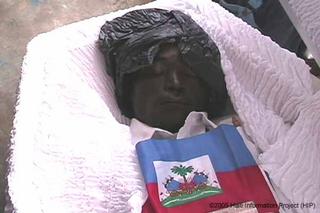
"Following another peaceful Lavalas demonstration on May 18, the Haitian police gunned down Sanel Joseph as he returned home. The rhetoric calling for U.N. military actions against the poor neighborhoods intensifies in the Haitian press as accusations of human rights abuses by the Haitian police are conveniently forgotten."
Masscre in Cite Soleil by UN forces?
The Haiti Information Project is reporting that "Haiti's UN forces Carry Out Massacre of Haiti's Poor in Port Au Prince." This is about an all out seige of the poor neighborhood of Cite Soleil that has been surrounded and under low level attack by Haitian police for at least a year. It seems that the UN forces stormed in and finished the job off claiming to be routing out "gang violence." However, it seems that any poor citizen living in the neighborhood was fair game as the troops attmepted to literally clear out the whole neighborhood.
HIP is reporting that fleeing citizens were shot in the back, and at least one resident seems to have been killed as they sat on the toilet.
The international media seems to have been silent about this, while the death toll sits at about 50.
How do we make this a story? It is already a week old and NO ONE knows that it happened
HIP is reporting that fleeing citizens were shot in the back, and at least one resident seems to have been killed as they sat on the toilet.
The international media seems to have been silent about this, while the death toll sits at about 50.
How do we make this a story? It is already a week old and NO ONE knows that it happened
Saturday, July 02, 2005
Religious extremists in Israel
This past week as revealed the ugly face of Israeli extremism. Usually when "religious extremism" is mentioned with regard to Israel, it is a reference to one of the islamic armed movements that attacks civilians like Hamas or Islami Jihad. There is usually a media oversight of the violence of Israeli power structure. For example, few are aware of the fact that the Israeli military has killed more civilians since the beginning of the recent intifada than have armed Palestinians.
That being said, this past week Israelis motivated by religious extremism have acted with such arrogance and violance that it is astounding. Beside the protesters in Israel that through nails and oil on major highways to cause accidents in protest of the withdrawel from Gaza, other protesters in Gaza threw rocks and fists at Israeli soldiers. They were very enraged that jewish israeli soldiers were treating jews in a harsh manner by arresting them. BBC shows a picture of a young boy in New York protesting Sharon's removal of settlers because forced removals are for Palestinians, the signs said "Don't do unto Jews what you won't do to Arabs."
Someone should remind them how luck they are not to be Palestinian. Palestinians who throw rocks are often killed by angry soldiers. This past week even saw the conviction of an Israeli soldier for manslaughter in the killing of the Briton Tom Hurndell. Hurndell was shot in the neck by a sniper for guiding children out of the line of fire. Some of these same extremist explained his death by repeatedly stating that he was wearing a gun and camoflouge at the time of his murder.
Lynch mob
CNN reported that a group of the Gaza extremists nearly killed a Palestinian who had the misfortune of being too close to the mob. They even showed footage of the man being beaten with rocks until he was unable to walk himself to safety. The last I heard was that he was in critical condition in the hospital.
Demolitions
While much talk has been made of the demolitions of settlements, BBC also reports that the Israeli military is stepping up home demolitions and the construction of the separation fence or "apartheid wall" (from the Afrikaans root meaning apartness or separation). This Gaza withdrawel is unfortunately working as a distraction from the continuing systematic violence of the occupation, and over-reassuring the Israeli public. The problem is that the withdrawal is limited, since the Israeli government promises continued military incursions while the territory remains unstable. Furthermore, the most ecomically viable Palestinian region (the West Bank) continues to be polluted, divided, and subjugated by the Israeli military and civilian authority.
A final word on Israel and Palestine
People who don't know me personally may take this commentary as "one-sided" or "anti-Israel." Unfortunately, Israel and the United States of America are two of the few countries that you are not allowed to criticize without being called hate-filled, anti-(place your fatherland here), or (in the case of Israel) anti-semitic (or a self-hating Jew if you, like me, are Jewish yourself).
Let me just say that I am equally dismayed by the religious extremism rising up in the Palestinian territories and the rest of the Muslim world. My Palestinian friends speak with frustration at how the democratic and pluralistic atmosphere of the first intifada is being replaced with religious-based intolerance and dogma.
However, in the case of much of the Muslim world, I have been told that Islamic fanaticism takes root best in areas (like Palestine) when hope in secular or humanistic politics seems to have failed or been crushed to a point of hope beyond hope. In areas where there is little or no hope, what will you put your trust in, a left-leaning populist who may be killed or be coopted? A secular system that may put food on the table ten years ahead while you are hungry now? Or will you put your faith with the almighty ruler and creator of the world, who promises hope beyond this life and immortality in faith?
I am more frustrated in the Christian, Jewish and Islamic extremists who are using religious ideology to further their own political and economic power. The Christian right shows immense hypocrisy and dangerous arrogance when it advocates war, economic, and AIDS policies that are designed to enrich themselves while others suffer. Would Jesus not throw the money-begging televangelists out of the temple? Would he not nail himself to the cross in protest for the sins of war? Would Jesus not side with the victims and potential victims of AIDS in search of prevention strategies (and condoms) as he walked with the prostitutes two thousand years ago?
And how can the Israeli extremists advocate racism and violent displacement against the citizens of Judea and Samarra (what Jewish fanatics call the West Bank as a reference to the Torah and a claim to ownership)? Is this not a selective reading of the Torah and a complete ignorance of some of the central themes of judaism like Tikkun Olam and Tzedekeh? Is it not also a reproduction of the spirit of racist Aryan entitlement of Europe that underpinned Nazi ideology?
In the Muslim world, one can easily condemn and vilify the puritanic authoritariansim embodied by the Iranian board of clerics and the violent acts of Pakistani local power structures that are justified by the religion of Islam. The indisciminate violence of Al Qaeda, underscored by the mass murder in London this week, is all the more despicable because the purveyors of this death claim heavenly rewards for the attackers.
Nevertheless, I wonder if the secular regimes in the region that have historically been supported by American politics have not done more harm and commited more murders and acts of violence. I am thinking of the governments like the ones based out of Baghdad (before 1990), Cairo, Damascus (on and off until the present date), and the house of Saud among others. The fact that racist neoconservatives and others are now calling for the toppling of these governments does not give them the right to ignore their own role in the violence and religious extremism sweeping the world.
That being said, this past week Israelis motivated by religious extremism have acted with such arrogance and violance that it is astounding. Beside the protesters in Israel that through nails and oil on major highways to cause accidents in protest of the withdrawel from Gaza, other protesters in Gaza threw rocks and fists at Israeli soldiers. They were very enraged that jewish israeli soldiers were treating jews in a harsh manner by arresting them. BBC shows a picture of a young boy in New York protesting Sharon's removal of settlers because forced removals are for Palestinians, the signs said "Don't do unto Jews what you won't do to Arabs."
Someone should remind them how luck they are not to be Palestinian. Palestinians who throw rocks are often killed by angry soldiers. This past week even saw the conviction of an Israeli soldier for manslaughter in the killing of the Briton Tom Hurndell. Hurndell was shot in the neck by a sniper for guiding children out of the line of fire. Some of these same extremist explained his death by repeatedly stating that he was wearing a gun and camoflouge at the time of his murder.
Lynch mob
CNN reported that a group of the Gaza extremists nearly killed a Palestinian who had the misfortune of being too close to the mob. They even showed footage of the man being beaten with rocks until he was unable to walk himself to safety. The last I heard was that he was in critical condition in the hospital.
Demolitions
While much talk has been made of the demolitions of settlements, BBC also reports that the Israeli military is stepping up home demolitions and the construction of the separation fence or "apartheid wall" (from the Afrikaans root meaning apartness or separation). This Gaza withdrawel is unfortunately working as a distraction from the continuing systematic violence of the occupation, and over-reassuring the Israeli public. The problem is that the withdrawal is limited, since the Israeli government promises continued military incursions while the territory remains unstable. Furthermore, the most ecomically viable Palestinian region (the West Bank) continues to be polluted, divided, and subjugated by the Israeli military and civilian authority.
A final word on Israel and Palestine
People who don't know me personally may take this commentary as "one-sided" or "anti-Israel." Unfortunately, Israel and the United States of America are two of the few countries that you are not allowed to criticize without being called hate-filled, anti-(place your fatherland here), or (in the case of Israel) anti-semitic (or a self-hating Jew if you, like me, are Jewish yourself).
Let me just say that I am equally dismayed by the religious extremism rising up in the Palestinian territories and the rest of the Muslim world. My Palestinian friends speak with frustration at how the democratic and pluralistic atmosphere of the first intifada is being replaced with religious-based intolerance and dogma.
However, in the case of much of the Muslim world, I have been told that Islamic fanaticism takes root best in areas (like Palestine) when hope in secular or humanistic politics seems to have failed or been crushed to a point of hope beyond hope. In areas where there is little or no hope, what will you put your trust in, a left-leaning populist who may be killed or be coopted? A secular system that may put food on the table ten years ahead while you are hungry now? Or will you put your faith with the almighty ruler and creator of the world, who promises hope beyond this life and immortality in faith?
I am more frustrated in the Christian, Jewish and Islamic extremists who are using religious ideology to further their own political and economic power. The Christian right shows immense hypocrisy and dangerous arrogance when it advocates war, economic, and AIDS policies that are designed to enrich themselves while others suffer. Would Jesus not throw the money-begging televangelists out of the temple? Would he not nail himself to the cross in protest for the sins of war? Would Jesus not side with the victims and potential victims of AIDS in search of prevention strategies (and condoms) as he walked with the prostitutes two thousand years ago?
And how can the Israeli extremists advocate racism and violent displacement against the citizens of Judea and Samarra (what Jewish fanatics call the West Bank as a reference to the Torah and a claim to ownership)? Is this not a selective reading of the Torah and a complete ignorance of some of the central themes of judaism like Tikkun Olam and Tzedekeh? Is it not also a reproduction of the spirit of racist Aryan entitlement of Europe that underpinned Nazi ideology?
In the Muslim world, one can easily condemn and vilify the puritanic authoritariansim embodied by the Iranian board of clerics and the violent acts of Pakistani local power structures that are justified by the religion of Islam. The indisciminate violence of Al Qaeda, underscored by the mass murder in London this week, is all the more despicable because the purveyors of this death claim heavenly rewards for the attackers.
Nevertheless, I wonder if the secular regimes in the region that have historically been supported by American politics have not done more harm and commited more murders and acts of violence. I am thinking of the governments like the ones based out of Baghdad (before 1990), Cairo, Damascus (on and off until the present date), and the house of Saud among others. The fact that racist neoconservatives and others are now calling for the toppling of these governments does not give them the right to ignore their own role in the violence and religious extremism sweeping the world.
Sunday, June 26, 2005
On the Lighter Side
Here is a cartoon i published when news came from the Vatican before the 2003 invasion of Iraq.


Friday, June 24, 2005
The exit of Bernard Gouse: The Release of Yvon Neptune
The Institute for Justice and Democracy in Haiti has a good article on the resignation of the Justice Minister for the coup government Bernard Gousse. Gousse had been very aggressive in keeping Lavalas activists in jail and thwarting legal challanges to free them.
Now reports are coming out, in the wake of this resignation, that a magistrate has ordered the release of Yvon Neptune.
Now reports are coming out, in the wake of this resignation, that a magistrate has ordered the release of Yvon Neptune.
Thursday, June 23, 2005
Jim Lobe from Inter Press Service has a good article about how the disaster in Haiti is yet another painful and powerful example of the failure and moral corruption of the United States' government policies violently promoting foreign "Regime Change." The beginning is excerpted below
Haiti: Another Regime Change in Trouble
"While the violence in Iraq continues unabated, the situation in Haiti, where the George W. Bush administration also played a key role in engineering regime change, is going from bad to desperate, according to increasingly worried analysts here..."
Haiti: Another Regime Change in Trouble
"While the violence in Iraq continues unabated, the situation in Haiti, where the George W. Bush administration also played a key role in engineering regime change, is going from bad to desperate, according to increasingly worried analysts here..."
Wednesday, June 22, 2005
Salvador Style Death Squads in Iraq
In January, American media started talking about Pentagon's plans to exercise a "Salvadoran Option" in the Iraq counter-insurgency fight. Since then, this concept has at once been accepted as true in some way and also been forgotten. Meanwhile, Iraqi commentators like riverbend in Iraq have commented on the increasing paramilitary style operations in Iraq targetting clerics who are openly against the occupation. Riverbend is quoted below:
"Almost every Iraqi family can give the name of a friend or relative who is in one of the many American prisons for no particular reason. They aren’t allowed to see lawyers or have visitors and stories of torture have become commonplace. Both Sunni and Shia clerics who are in opposition to the occupation are particularly prone to attacks by “Liwa il Theeb” or the special Iraqi forces Wolf Brigade. They are often tortured during interrogation and some of them are found dead."
Max Fuller of the Centre for Research on Globalization has pointed also out that the recent discovery of mass graves have been in areas where the new Police Commando Units in the Iraqi Army are located. It is unclear to me if these are the same units that Riverbend calls the special operations "Wolf Brigade" of the Iraqi Army.
From Max Fuller's article
"
This analysis is not exactly scientific, but it is a bad sound, and i doubt it will be the last we hear about these "commando units" in the same paragraph as the words "death squads."
"Almost every Iraqi family can give the name of a friend or relative who is in one of the many American prisons for no particular reason. They aren’t allowed to see lawyers or have visitors and stories of torture have become commonplace. Both Sunni and Shia clerics who are in opposition to the occupation are particularly prone to attacks by “Liwa il Theeb” or the special Iraqi forces Wolf Brigade. They are often tortured during interrogation and some of them are found dead."
Max Fuller of the Centre for Research on Globalization has pointed also out that the recent discovery of mass graves have been in areas where the new Police Commando Units in the Iraqi Army are located. It is unclear to me if these are the same units that Riverbend calls the special operations "Wolf Brigade" of the Iraqi Army.
From Max Fuller's article
"
In the last few weeks, with the discovery of several mass graves in and around Baghdad, evidence of multiple extra-judicial killings has started to become much more visible, but, in fact, even a cursory review of such archives as the one compiled by Iraq Body Count (http://www.iraqbodycount.net /) reveals that mass executions have been taking place commonly in Iraq over at least the last six months. What is particularly striking is that many of those killings have taken place since the Police Commandos became operationally active and often correspond with areas where they have been deployed.
The clearest correlation is in Mosul, where the Police Commandos began operating in late October"This analysis is not exactly scientific, but it is a bad sound, and i doubt it will be the last we hear about these "commando units" in the same paragraph as the words "death squads."
Thursday, June 16, 2005
The ambassador for Haiti's coup on CSPAN
I was told that the ambassador for the coup government in Haiti was on CSPAN yesterday. I have not seen it yet, but it was described to me in the following manner:
"Ugh. Haiti's so-called ambssador to the US, Raymond Joseph, was on the
last 1/2 hour (9:30-10:00 am EDT) segment of CSPAN this morning. I
missed the first 10 minutes, but here is what I got from it:
-On 3 or 4 occasions he said that President Aristide had created
numerous factions in poor neighborhoods and he referred to these
factions as "the Sadam Hussein Army , Red Army, Cannibal Army" -- it
was pathetic because he kept repeating it like a mantra
-He said that Haiti would welcome the US Marines and when asked how many
Marines might be needed in Haiti, he said that since Haiti has about the
same number of people as NYC, Haiti should get the same number of
Marines as NYC has police -- 50,000. (I'm going to check on this figure
when the videotape is posted).
-When the interviewer raised the story about the 10 Democratic members
of Congress who signed the letter to Condi Rice saying that the
US-backed interim gov't. in Haiti was an "instrument of repression,"
Joseph responded that he was glad "it was only 10" democratic members of
Congress. He said that the Democrats have not been particularly
supportive of Haiti.
The people who got through on the phone focused on things such as
adoption and travel to Haiti.
Probably within a day or two you can go to the C-SPAN site:
www.c-span.org and click on Washington Journal for Sunday, June 12 and
see the videotape of the show."
The story about Aristide's hideously named army factions is obviously invented. He might as well have called Aristide "Skeletor." It is still the same story line as the one that the Haitian government and media were spreading about "Operation Baghdad" in which thugs in the slums were said to be turning to Iraqi tactics of kidnappings and beheadings. This language was picked up by the AP and the BBC and has sinced been used by Haitian government officials. However, Haitian protesters and the Lavalas party have repeatedly said that the "operation" was an invention of the interim governemnt or the pro-coup media. It is a blantant campaign of lies to manipulate international opinion against the elected government and Haitian democracy.
This government official should be held accountable for such deception. Do we really want to send more American Marines to do the dirty work for the CIA, based on such blantant lies as those above?
"Ugh. Haiti's so-called ambssador to the US, Raymond Joseph, was on the
last 1/2 hour (9:30-10:00 am EDT) segment of CSPAN this morning. I
missed the first 10 minutes, but here is what I got from it:
-On 3 or 4 occasions he said that President Aristide had created
numerous factions in poor neighborhoods and he referred to these
factions as "the Sadam Hussein Army , Red Army, Cannibal Army" -- it
was pathetic because he kept repeating it like a mantra
-He said that Haiti would welcome the US Marines and when asked how many
Marines might be needed in Haiti, he said that since Haiti has about the
same number of people as NYC, Haiti should get the same number of
Marines as NYC has police -- 50,000. (I'm going to check on this figure
when the videotape is posted).
-When the interviewer raised the story about the 10 Democratic members
of Congress who signed the letter to Condi Rice saying that the
US-backed interim gov't. in Haiti was an "instrument of repression,"
Joseph responded that he was glad "it was only 10" democratic members of
Congress. He said that the Democrats have not been particularly
supportive of Haiti.
The people who got through on the phone focused on things such as
adoption and travel to Haiti.
Probably within a day or two you can go to the C-SPAN site:
www.c-span.org and click on Washington Journal for Sunday, June 12 and
see the videotape of the show."
The story about Aristide's hideously named army factions is obviously invented. He might as well have called Aristide "Skeletor." It is still the same story line as the one that the Haitian government and media were spreading about "Operation Baghdad" in which thugs in the slums were said to be turning to Iraqi tactics of kidnappings and beheadings. This language was picked up by the AP and the BBC and has sinced been used by Haitian government officials. However, Haitian protesters and the Lavalas party have repeatedly said that the "operation" was an invention of the interim governemnt or the pro-coup media. It is a blantant campaign of lies to manipulate international opinion against the elected government and Haitian democracy.
This government official should be held accountable for such deception. Do we really want to send more American Marines to do the dirty work for the CIA, based on such blantant lies as those above?
Wednesday, June 08, 2005
Murder in Uzbekistan
It is becoming increasingly clear that the Bush administration's allied government in Uzbekistan was involved in murdering hundreds of protesters after a jail break of what the Uzbeki government calls "islamic extremist." The killing appears to have continued during separate incidents for days after the initial "massacre" (as Human Rights Watch calls it).
A report on the Human Rights Watch analysis.
According to BBC, Uzbekistan "s still the springboard for US operations in Afghanistan, while a group of U.S. senators headed by John McCain has demanded an investigation, I have been unable to find any White House comment.
A report on the Human Rights Watch analysis.
According to BBC, Uzbekistan "s still the springboard for US operations in Afghanistan, while a group of U.S. senators headed by John McCain has demanded an investigation, I have been unable to find any White House comment.
Tuesday, June 07, 2005
Update: Targetting media misrepresentations of Haiti and seige of Cite Soleil
The bloddy seige of Haiti's slums has begun. BBC reports that the terror tactics of the former death squads including killing those in the streets and burning houses, though BBC is calling these "gang raids."
Haiti News Watch has just published two articles discussing systematic misrepresentations of the situation in Haiti by the BBC and the Associated Press.
HNW says that "The BBC, for unknown reasons, ignored important key observations of the report and provided readers with a condensed "interpretation" that blamed Haiti's violence solely on politically motivated "warring gangs." The BBC utterly ignores the report's assessment of the role of politically non-aligned groups such as drug traffickers and the violence of the Haitian police. "
The question is... ¿How do we publish these facts in a way that makes the BBC defensive and self critical about being truthful in its coverage? ¿Is that possible?
I have been emailing BBC with similar complaints about their coverage. I just sent the following letter to newsonline@bbc.co.uk
----------------------
Esteemed editor,
I came across the following story on BBC's coverage of the recent report on Haiti. I think the Haiti News Watch is right on, but i thought i would ask for BBC's response before i made up my mind.
http://www.haitiaction.net/News/HNW/6_1_5/6_1_5.html
this is in response to the BBC article here
http://news.bbc.co.uk/2/hi/americas/4599369.stm
from June 1
thank you in advance for your accountability
Simon Fitzgerald
---------------------
Haiti News Watch has just published two articles discussing systematic misrepresentations of the situation in Haiti by the BBC and the Associated Press.
HNW says that "The BBC, for unknown reasons, ignored important key observations of the report and provided readers with a condensed "interpretation" that blamed Haiti's violence solely on politically motivated "warring gangs." The BBC utterly ignores the report's assessment of the role of politically non-aligned groups such as drug traffickers and the violence of the Haitian police. "
The question is... ¿How do we publish these facts in a way that makes the BBC defensive and self critical about being truthful in its coverage? ¿Is that possible?
I have been emailing BBC with similar complaints about their coverage. I just sent the following letter to newsonline@bbc.co.uk
----------------------
Esteemed editor,
I came across the following story on BBC's coverage of the recent report on Haiti. I think the Haiti News Watch is right on, but i thought i would ask for BBC's response before i made up my mind.
http://www.haitiaction.net/News/HNW/6_1_5/6_1_5.html
this is in response to the BBC article here
http://news.bbc.co.uk/2/hi/americas/4599369.stm
from June 1
thank you in advance for your accountability
Simon Fitzgerald
---------------------
Subscribe to:
Posts
(
Atom
)