Tuesday, October 12, 2010

Liu Xiaobo's Nobel Prize on a Hazy SaturWorkDay in Beijing

This weekend weekend on a hazy work day on a Saturday in Beijing.  Since this past week was the week-long national holiday celebration, yesterday was a national day of make-up work when all Chinese employees are expected to report to work.
Night time pollution shines like halos around the Beijing street lights.

The haze hides the buildings across the street.

After a string of blue sky days last month, pollution has been particularly bad for Beijing this October.  According to the US Embassy Twitter feed on air quality (banned from China's networks), the particulate matter levels have been at "hazardous" levels for the fifth straight day.  As an international conference of the United Nations Framework Convention on Climate Change 60 miles away in Tianjin "shows little signs" of progress, the haze has clouded the sun in an eerie bluish blanket like something out of a science fiction movie from the not so distant future.   Meanwhile, the China Open tennis tournament has had to turn on the flood lights during midday matches, and, as reuters reports
Air quality is so bad at the China Open in Beijing that players should have access to oxygen tanks on court to help them breathe through the smog, says world number two Novak Djokovic.
Back in Oslo, the Nobel committee awarded the 2010 Nobel Peace Prize to imprisoned Chinese dissident Liu Xiaobo ( 刘晓波).  The former Columbia University literature professor has been a human rights activist since leaving his American position to join the hunger strikers during the 1989 Tiananmen Square protest (similar to the Mongolian protests the next year) and June 4th "Beijing massacre," did his first term in prison, detailed in an LA Times feature.  He will spend the his awards ceremony in a Chinese prison cell where he is serving an 11 year sentence for "subversion" for drafting a circulating a petition known as Charter 08 to allow more political and press freedom in China (named after a similar petition of the Czechoslovakians during the Prague Spring of 1968 quite similar to the Cuban Varela Project in 1998 made possible by the internet that used the limited legislative institutions to push reform).

The Chinese government responded with threats to Norwegian-Chinese relations and coercive silence internally.  In general, the topic of the Tiananmen protests of 1989 is still not up for discussion, as google has found out (A brief history is online at the NYTimes).  Though unprecedented and something of a turning point in recent Chinese history, young people are not generally aware of the events of that Spring.  Even the physical landscape of the Square has been changed in the last two decades, sorrounded by gates, checkpoints and metal detectors that prevent any free movement that could create a situation that even briefly looked like 1989.

During the Nobel committee's announcement, CNN and BBC were completely blacked out.  Afterwords, Chinese websites removed all mention of the Nobel Peace Prize, and "Liu Xiaobo" and the "Nobel Peace Prize" were censored from search engines. Within Chinese media, the prize was only discussed in one English language editorial in the Global times (bemoaning the "anti-China" purpose of the prize "loaded with Western ideology" that wants to see China collapse like the Soviet Union).  The foreign ministry reportedly described the decision as "blasphemy."  The controversial cartoonist Kuang Biao reportedly put a cartoon of the nobel prize behind bars on his sina.com blog, but I have been unable to find the image.

Liu Xiaobo for his part has not been able to communicate with the world outside of his prison.  His wife was taken out of Beijing by uniformed police who kept her from a press conference she planned to hold, and  told her she was being taken to visit her husband.  She is apparently now on house arrest.  Deutche-Presse reports that many activist colleagues of Liu Xiaobo have been followed, put on house arrest, or taken into custody.  According to the report from this weekend, some activists seem to have been disappeared.  Their phones are not working and no one had yet heard where they were at the time the article went to print.

The Washington Post has an editorial suggesting that the prize may do Liu and his allies more harm than good.

The legacy of the 1989 protests is a complicated and controversial topic that i am ill prepared to write much about, but its echos clearly continue bouncing a generation later, as in this case, from the cell blocks of Jinzhou prison to the stage of Oslo's City Hall.

Thursday, October 07, 2010

National Holiday in Yangshuo

I spent the Chinese National Day holiday in the city of Yangshuo (阳朔县).  Since the Chinese government extended the holiday several years ago to a week-long affair, domestic tourism has increased exponentially in the area, with karst formations with impressive peaks, scenic river rides and some of the best rock-climbing in China.  The resulting crowds, tourist traps and confusion left me feeling at times like this first image from our arrival.

Wednesday, September 29, 2010

Retire the Dragon

I've been considering some more news commentary while so far away so people interested in how my mind is changing can watch the world reflect off my computer screen.  The trick, of course, is not to misspend too much time doing it.

But for those who found the dragon image I referenced for China in my first post to be a tired cliche, Christina Larson at Foreign Policy shows you are not alone.

Sunday, September 26, 2010

The Rebirth of Chinggis: A laowai's glimpse at 21st century Mongolia

The glistening image of Chinggis Khan
Ulaan Baatar- Sandwiched on a plateau between global powers Russia and China, it is easy for an American ignorant of the region to imagine the sparsely populated Mongolia as a marginal nation that will forever be coerced in the shadow of its giant neighbors.  Of course, Mongolians remember that, at its height, the Mongol empire was the largest land empire, stretching from Bulgaria to Korea. Since the fall of the Soviet Union, the Mongolian national identity has been rising like a 130 foot steel image of Genghis Khan (known locally as Chinggis Khan).

Mongolian religious art and culture culture, from what I can gather, appears to be a rich mix of traditional shamanistic practices and buddhist influences from afar as Tibet and India.  The art and iconography of Mongolia's buddhist temples, ritualistic masks and traditional dress is intensely colorful, powerfully violent at times, erotically sexual at others, and suprisingly psychodelic.  

Masked dancers of the Tumen Ekh National Song and Dance Ensemble.

Other ethnicities, including the Kazakh, add layers of different traditions, designs, art and rituals.  With a semi-nomadic herding tradition, the basic unit of social organization is the Ger, a home that can be built in 60-90 minutes and taken apart in half as much time with materials that can be shipped on the backs of camels or horses.  
Twin gers of relatively affluent Kazakh herding family with wind turbine and solar panel (on right ger just above and to the side of the entrance.  Their herd of sheep is visible in the distance to the viewers left.)


Southwestern Mongolia is also believed to be where throat singing began.  The singing styles based on the harmonies of the singers voice of resonant overtones in the throat and mouth are essential parts of Mongolian art, and even the chanting styles of Buddhist monks I saw in the Gandantegchinlen Monastery (pictures not included).  
Throat singing with the Tumen Ekh ensemble.  I'm afraid I failed to save the names of the singer or the musicians.


This style of singing has become famously associated with Mongolia's northern neighbor, the Tuva Republic (part of Russia), from the documentary Genghis Blues in which blind American blues singer travels to Tuva for the first time to win the Tuvan national throat singing championship (a clip is on Youtube, forgive the German subtitles).
Address:

Tall Shadows
The standard English language historical text in the Mongolian Museum of National History, as well as the bookstores and gift shops of Ulaan Baatar, is Baabar's History of Mongolia: From World Power to Soviet Satellite, printed in a joint venture by Cambridge University Press and Mongolian national publishers.  

Baabar describes how the 1911 Mongolian independence became possible with the the imminent collapse of the Qing dynasty which had dominated Mongolia as a foreign power.  With the Bolsheik revolution to the Northwest, both Russian White Guard and Chinese nationalist troops invaded in 1917.  This era included a Russian dictator with a ragtag army of soldiers from Eastern Europe to Japan named Roman Ungren von Sternberg whose wikipedia page is just too bizarre for me to comprehend.   

While the national government failed to raise enough support and troops to throw out the invaders, several rebel groups organized into the Mongolian People's Party enlisted the aid of the Soviet army, starting a series of events that would shape the future of the Mongolia for the next 70 years.  With military might came political advisors.  After the Czarists and the Chinese were defeated, a process of sovietization of the society over the next generation collectivized farms and other property in 1928.  This was wildly unpopular with many Mongolians, particularly the nobility and Buddhist clergy.  Disorganized rebellions were easily put down with Mongolian-Soviet military power into the early 1930s, coinciding with a war against the Japanese over control of parts of Mongolia.  With Soviet propanda against Japanese spies, a whole generation was purged.  Climaxing in 1937 with mass murder of almost the entire Buddhist clergy and the execution of the exiled prime minister Genden who refused to carry out the purge, no level of Mongolian society was spared the purge.

This history seems to be an important part of the Mongolian national consciousness.  A Museum of Political Persecution was founded documenting much of this.  But, with the exception of the bullet riddled skulls excavated in 2003 from a Soviet mass grave in Mongolia, the museum is poorly organized for an English-speaking audience.
Bullet riddled skulls excavated in 2003 from a Soviet mass grave in Mongolia.

Zorig and the New Mongolia
Soviet control of Mongolian affairs continued into perestroika, but in the late 1980s several organizations, particularly the Union of Mongolian Composers, created space for students and young adults to openly discuss politics and the future of Mongolia.

From this energy sprung the Mongolian Democratic Union, which organized protests and open letters, some carried in the press, calling for elections with a multiparty system and basic political freedoms.  The coming out party for this movement, described well in an excerpt of Mossabi's Modern Mongolia: From Khans to Commissars to Capitalists, was a small but boisterous December 10 1989 Human Rights Day Protest in Sükhbaatar square.  Though Rossabi argues that the demonstrations reflected divisions within the ruling Mongolia People's Revolutionary Party, the government did not respond to the demands, the protests swelled in size and became increasingly rowdy, immortalized by the photo of Sanjaasürengiin Zorig, the "Golden Magpie of Democracy," calming the crowd as it seemed about to lay seige to government offices.  The confrontation ultimately climaxed in a March 1990 hunger strike demanding that the entire politburo of communist leadership resign, arrange for multi-party parliamentary elections and separate Mongolian government functions from MPRP party functions.  By mid-April Mongolia had entered a new phase in its history.
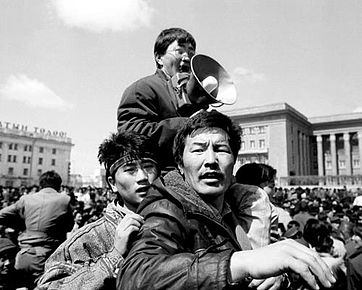
Infamous photo of Sanjaasürengün Zorig from Mongolian newspaper reports from early 1990.  I am unable to find the photographer's name.
Sükhbaatar Square now is a center for congregation for young and old; bicycle, roller blade and power wheel

Language
During my first moments in Mongolia, reading the cyrillic script and overhearing fragments of conversations in a language where I could barely distinguish the syllables, there was something extremely foreign and somewhat intimidating in the Mongolian language.  I imagined that the Klingon language might have been modeled after Mongolian, carrying its history of conquest under the Mongol empire and representing a Soviet styled nemesis of the USA-like Federation of  planets.

Of course, that impression reflected more on my ignorance than on the Mongolian language.  Though written in cyrillic, it is not at all a slavic language.  Several alphabets pre-existed the use of cyrillic, famously including the alphabet introduced by Zanabazar shown below whose first symbol is on the Mongolian flag.  
Part of Soyembo alphabet introduced by Zanabazar in the 17th century.

Another alphabet was used in the pre-soviet area, and was elegant enough to be used on typewriters.  


However, at that time illiteracy, especially among herders, was the norm.  As part of the literacy programs devised under soviet advisors in the 1930s, the cyrillic alphabet was adapted and taught all across the country.  The result was a linguistic as well as economic and cultural Sovietization.  While the traditional scripts are still studied, as are Tibetan and Sanscrit in this Buddhist country, they are still only marginally used in public context outside of the monasteries and universities.

Post-Soviet Discontent
Though Mongolians are apparently quite proud of the peaceful transition from Soviet domination to a new Mongolian national identity, the post-Soviet era has also been wrought with disappointment, corruption and inequality.  There is a palpable tension in Mongolia, a mix of frustration and aggression that is simmering underneath the apparent economic growth and outward political stability.

The post-Soviet transition to democracy also left Mongolia's economy without the Soviet support it had become dependent on.  Before 1990, the exchange of Mongolian Tugriks to the American dollar was about 10:1.  Now that ratio is above 1300:1.  The period of privatization was heavily directed by foreign lending institutions such as the IMF, World Bank and Asian Development Bank, resulting in a defunding of education and health care.  The mining sector was being increasingly exploited by foreign corporations with relatively small benefit to the Mongolian economy.

The "end of the romantic phase of post-Soviet Mongolia" occurred in 1998 when Sanjaasürengiin Zorig was stabbed to death in his apartment the day he was nominated as the candidate for Prime Minister.  His widow speculated that the still unsolved crime was related to corruption in the privatization phase that Zorig refused to participate in or allow.  

I met a highschool English teacher who was skipping work at school to make money as a guide to foreign tourists because of the difference in money.  She hoped to give up teaching and help her sister start and run a hostel.  Our driver says he was a doctor trained in women's health, (though he also claims to have been a gun and drug runner with the Mongolian mafia in 1990s until he was shot at and decided that wasn't the life for him).  He says he gave up working as a doctor in order to work for a tourism agency for better pay and lifestyle.

This distortion of economic incentive is not the recipe for good social and economic development.  Despite the apparent boom of construction in Ulaan Baatar, as numerous cranes tower over the city, many construction sites are half-finished shells with no signs of active construction.  Some streets are coming apart, and there is a strange sense of growth and decay at the same time.  The national recreation park contains a new amusement park with rides and bumper cars, but the rest of the park around it seems like a scene out of the depressing "Return to Oz" movie.


While the poor outskirts of most modern cities like Mexico City are defined by the shanty town, Ulaan Baatar is wringed with Ger districts of new rural to urban migrants in search of work.  Particularly bad winters at the end of the 1990s led to an increase in poor immigrants and a rush of homeless children, many of them living in the sewer, a number of them involved in prostitution.  Since then more orphanages and NGOs such as Save the Children have been addressing the problem but it continues.  Violent crime and property crime also appear to be on the rise.

The ecology and economy of the Ger show similar dichotomies.  Some gers have wind turbines and solar panels to charge the batteries they run their household electronics off of.  Those with substantial herds can burn the dung for energy, but they also apparently burn and dump the trash, much of it plastic.  The drainage ditches and roadsides of Mongolia are sadly decorated with plastic wrappers, drink bottles, and broken glass.

Mongolian Fascism and the Duality of the Swastika (Khas)
The failures of the post-soviet democratic leadership to provide economic stability for Mongolia have occurred in the context of simmering resentment towards Mongolia's Soviet experience and socialist ideals and animosity toward foreign interests profiting in Mongolia.  This has created fertile ground for what would seem an unlikely location for the rise of Nazi-inspired Fascism.
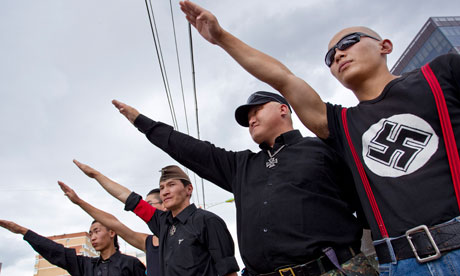
Photo: Dan Chung of The Guardian newspaper

Youth fascists have been involved in increasingly common incidents of violence targeting inter-racial couples, homosexuals, transsexuals, foreigners (especially Chinese) and Mongolian women associating with foreigners.  NPR describes a recent "song by a band called 4 Zug. The title: 'Don't Overstep The Limits, You Chinks.' It is a violent, hate-filled tirade against Mongolia's massive neighbor, China."  After shopping for a made in Mongolia hat and jacket at the "Black Market" of Naran Tuul, I met one such shaved head youth wearing a German cross pendant around his neck throwing a punch in my direction. 

Many have pointed out the irony of a Mongolian political philosophy respectfully modeled after the racist Nazi policies that targetted Mongolian POWs for execution.  Perhaps more interesting is how Hitler's rebranding of the swastika, a Hindu and Buddhist symbol, as a Nazi emblem gives fascism a strange symbolic connection to the pre-Soviet Mongolian buddhist tradition.

The symbol, called a "Khas" in Mongolian appears not only in traditional design, but in traditional games and on the first Bank Note of the Republic of Mongolia in 1921. 
It was explained to me to be something like a spiritual compass rose, taking in energy from the four cardinal directions and unifying it into oneness.
Though my Mongolian is woefully inadequate.  I believe this book states that traditionally the Khas was part of a spiritual machine that kills fascists.

So Much to Say: I've Said too Much
Its impossible for me to do justice to the Mongolian experience with 5 days and no Mongolian education.  The future of Mongolia remains in contention, poverty remains rampant while social services like transportation, education, health care and child care are in ruins.  While a sparsely populated country, the lack of clear ecological policies are going to catch up with the Mongolian environment.  The youth movements, in tension between the democratic revolutionaries of the previous generation and the rise of Mongolian hip-hop culture, are significantly influenced by fascism, but its impossible for me to appreciate other influences and the dynamic between them all.

As I return to work in Beijing, I can't help but fantasize about interesting possibilities for a health worker collaborating with Mongolian doctors and researchers to push the standards of Mongolian health care...

ed. note: The phrase laowai is an anglicization of the Chinese 老外 (lao wai = old foreigner).  See the 1st post from China for more.

Friday, September 24, 2010

Monday, September 20, 2010

Beijing to Ulaan Baatar

Улаанбаатар
Ulaan Baatar- This weekend I took the long train ride from Beijing to the Mongolian capital on a Mongolian Railway train.  The 20 hour trip included a surprisingly fun three hour layover at Erlian (二连浩特).


My Fogarty colleague Sarah planned most of the trip.  From Summer in Beijing, its quickly becoming winter weather in the desert of Mongolia, with nightly lows below freezing this week.  With much more to say, it will have to wait.  The early Mongolian morning calls...


Sunday, September 12, 2010

Beach House in the Big Leagues

Now that Beach House is in the big leagues, when they coming to tour China?

More on Changping

I thought i would include some pictures of where I've been spending some time.
The first shows the gleaming glass facade of the proud new CDC building, complete with fountain and flags of China and the CDC logo.
From large hill on campus, the CDC in its context.  Beyond the cafeteria in the near background, there isn't much else before the mountains in the distance.
Shuttle buses line up to take people home at 4:00.  Don't miss the bus, or you might have to find your own way home.  I like the texture of this picture, but I noticed that I caught this sign as far down as the Boiler Room.

If you can read what comes below Boiler Room, you may understand why i was later disappointed I missed "动物中心" in the photo above.   Its one of those details that rewards a viewer who takes time to really see the whole picture.


洗手间 
The experience of the Chinese bathroom is also a little different, and worth noting (without getting dramatic about the Asian-style squat toilet).  I've had the strange experience of walking into the bathroom of the national center for disease control and prevention and hearing diarrhea and smelling cigarette smoke.  It's strange to imagine an individual in that situation, but i suppose it may mask the bathroom smell.

Here is an example of a shiny clean squat toilet complete with cigarette butt.


Perhaps even more strange to me was the use of the western toilet stall for storage for the week or so that some building maintenance and repairs were going on.
These are just the minor details that color one's sense of being foreign.  More soon on the deeper meaning of work and life in China.

Sunday, September 05, 2010

感冒

我感冒
This was a pretty miserable week for me.  I went to bed Sunday night with some aches and an increasing fever that gave me some delirious dreams.  Monday I awoke with a headache, some disorientation and malaise.  On Tuesday I stayed home, and while the headache was a little better, I developed a productive cough with green sputum.  This all gradually has been improving, with some interspersed moments of near syncope.  Whether this was viral, or more likely some bacterial illness,  I learned the word 感冒, cold or flu, which apparently hits Western visitors to China particularly hard.

Hopefully, my sickness hasn't discolored my outlook on life in Beijing too much.  On the bright side, though one of the teachers on ChinesePod states that "everyone in China has diarrhea... right now," at least I don't have 拉肚子.

Beijing Commute
My daily routine begins shortly before my 5:40 alarm every morning.  I have a habit of nervously waking up at the first signs of a lit sky, usually around 5:38.  After getting dressed and packed for work, I walk 5 minutes to a shuttle bus.  I might stop by a store for this great honey sweetened yogurt for 2 rmb (about U$0.25, plus the deposit on the ceramic container).

My shuttle bus picks up in front of the buildings that, until this past year, were the headquarters of the China CDC.  The China CDC was founded in 2002 by the Chinese Academy of Preventive Medicine as a quasi-governmental NGO with ties to the Ministry of Health.  Its founding was described in the paper, The Current State of Public Health in China, which I cited in my previous post.  The office was opened up in four buildings just West of 天坛 (Temple of Heaven), shown by the arrow on the map of Beijing below.

After eight years, the CDC was overflowing, and began to rent out space from a hotel across the street.

In the interest of more space, a sprawling suburban campus some 40-50 kilometers out of Central Beijing, behind a cornfield in the Changping District.  On the above map it... does not fit.  Zooming out, here it is, identified with the arrow north of the Sixth Ring Road.

Since there was little mass transit to that cornfield before the CDC moved in, and since car ownership is still relatively low among Chinese workers and students, China CDC has to provide shuttle buses from more than a dozen different neighborhoods around the city.

My commute takes an hour to work every day (without traffic) and 75-100 minutes on the way home when traffic is worse.  Though some have been asking, I have not been stuck in the 10,000 car traffic jam or the 10 day traffic jam.  While those epic calamities are farther in the country-side, this town is still daily gridlock.

我工作
I have spent the last couple of weeks starting my job as a researcher/data analyst at the China CDC.  I gave my first presentation on Friday updating my boss and colleagues on my work analyzing the geographical differences in anemia in Chinese elderly, and preparing to use CDC data to find an appropriate level of hemoglobin to use as a definition of anemia among this population.  It was four days of data analysis, since I only made sense of the data at the beginning of the week (it's mostly in Chinese, I needed an English copy of the survey, etc.).  But I guess the presentation was satisfactory, since my boss suggested I give him a draft of the paper in 2-3 weeks...

Saturday, September 04, 2010

New Nikon: First Fotos

Dancing statues across from Tianqiao Acrobatics Theatre
Beijing disappears into the haze outside the 摄影器材城 where I bought this camera

Friday, September 03, 2010

Los desaparecidos de hoy

Violence on the Homefront
The last week brought a wave of notable stories related to violence on the homefront.  The tragic killing of a Jamaican-born hustler and hip hop record executive Jewish convert brought a good New York Times article on the black orthodox Jewish community of (where else) Brooklyn.  The Baltimore Sun highlighted the return of a long time teacher to kindergarden classroom for the first time since a former pupil murdered her son.  And several random attacks on Central Americans in Baltimore, including the beating death of a 51 year-old Honduran by a 19 mentally ill man who reportedly "hated Hispanics," and the shooting of two Hondurans (one fatally) by a 14-year-old girl in East Baltimore.

Desaparecidos: Ahora y Entonces
In Mexico, the bodies of 72 South and Central American migrants were found stacked in a shed, after one survivor managed to alert police after being shot in the throat.  This mass grave is one of a string of recent findings of mass graves in abandoned mine shafts, ranches, and shallow pits.  Most of the recent mass graves are thought to be where rival drug gangs are burying the bodies of their slain rivals, many of them showing signs of torture.

This new find raises questions to me about that narrative.

The bodies of a couple hundred forgotten migrants already litter the deserts of the USAmerican Southwest every summer.  Countless more Cubans and Haitians have disappeared in the Straights of Florida heading North.

Los Dasaparecidos, also a song by Rubèn Blades, refers to those left-wing, community and/or labor activists kidnapped off of the streets and imprisoned, tortured, exiled, murdered and sometimes thrown into the sea.  Originally coined in Argentina, where the torturers became known by their green Ford Falcon, the phenomenon was common in Brazil, Chile, Colombia, El Salvador, Guatemala, Mexico, Panama, Peru and Uruguay and other places around the world.

It strikes me that the disappeared of our world may not be always much the community organizer that political power hopes to silence (though they are certainly at risk in today's world), but also the poor people that private or corporate power (such as the cartel) find disposable (as perhaps the powerful so often do).

Thursday, September 02, 2010

From Motherland to Forbidden Fruit

My roommate has started posting a series on her blog about her recent trip to North Korea.  I passed on the trip offer, largely because of the expense and the strictly controlled movement.  I must sound so boring.

Saturday, August 28, 2010

The humorous, quotidian and more

For those interested in funnier moments of daily life in Beijing, as well as the deeper identity issues of a Chinese/Taiwanese-American returning to the country where her grandparents' families were separated by Mao's revolution, check out my flatmate's blog "Han Solo: Return to the Motherland." You can see pictures of me in a Beijing Bikini in 天安门 (Tian'anmen Square), pictures of our apartment, and a menu featuring "Pot-Braised Pig Fallopian Tube."

As Mercedes Sosa (whose triumphant 1982 concerts at Teatro Colòn upon returning from exile to Argentina give me goose bumps every time I listen) used to sing:

"lo cotidiano se vuelve màgico."

Sunday, August 22, 2010

老外在北京

老外在北京
New York and D.C. are often described as the "Belly of the Beast" or the "Brain of the Monster" by those critical of American Power.  China, on the other hand, has been given the mythical image of the dragon, including National Geographic's recent "Inside the Dragon" issue.  China certainly has entered the world economic stage like a Bruce Lee movie. (ed. note: Enter the Dragon)

If China's economic engine has been the dragon, its cities have become the dragon's lair.  Much has been written of the thick smog that usually blankets Chinese cities like Beijing, especially in the time around the arrival of the Olympics.  The US embassy now has a twitter feed with up to date information on the air quality (the irony of course is that twitter, like blogger.com is hidden from Chinese networks behind so-called The Great Firewall of China).  The haze sometimes obscures the view of the building across the street or hides the sun for days at a time.  At times I wake up with a little sore throat, or feel my asthma assert itself after long day, but this morning I woke up to a beautiful clear blue sky after last night's rain.  While i still don't have a camera (pictures to follow eventually) its worth sharing some of my first impressions as an ignorant 老外 (lao wai = old foreigner.  Its my Chinese name) 在 (zai = in) 北京 (Beijing).

Contradictions

Beijing is massive.  Home to more than 20 million people from almost every country of the world and every province in China.  Like a mix of Manhattan, Mexico City and Havana (only safer and full of Chinese speakers) it seems to have everything, from wealth, luxury and high technology to poverty and debris. 

Its seems a collision of traditional and modern.  As the United States, founded as the land of the free and the home of the slaves, is full of contradictions, my limited understanding of China is framed by a web of contradictions.  Because the language, history, culture and concepts here are still largely foreign to me, there is much I cannot perceive.  I anticipate I won't be able to reconcile my reality for quite some time. 


Here the most powerful communist party in the world leads one of the most aggressive capitalist economies. While increasing numbers of cars chase bicycles off its street, China is becoming a world leader in green energy technology like wind turbines.  Sometimes the contradictions are surreal, such as the view of  a Wal-Mart megastore in Caishikou from the rubble of a demolished hutong (胡同) neighborhood.  Other times it is farcical like taking the toboggan ride down from the great wall in Mutianyu. 

Anarchy in the PRC

But now is a very exciting time to be in China.  Possibilities seems limitless.


A Beijing-based musician explained to me the political significance of various youth movements, and I've come to realize that the cultural space has opened up tremendously.  The rock scene has been so energetic that analysts have taken to calling it Anarchy in the PRC, referencing the Sex Pistols "Anarchy in the UK" and the 2002 collaboration by Chinese punk groups Brain Failure and Anarchy Jerks pictured at left.

Health Care in China

I've spent part of the last week researching the history of public health in China.  China obviously has a rich, ancient tradition of medicine and a track record of advances in rural medicine early in the second half of the 20th century.  However, there is consensus that the current health care system is dysfunctional.  The Washington Post described the situation of the Chinese health care system during recent debates over health system reform in the United States.  The New York Times described so much distrust between doctors and patients that armed confrontation in the hospital is not entirely uncommon.   A recent report from the China CDC stated that 
Old operating models of public health cannot meet present requirements... [because of]... poor capacity to respond to public health emergencies, severe inequality of health care services, and lagging development of public health information systems.
农民工
This dilemma faced by Chinese policy makers particularly and Chinese society in general are illustrated to me by the conditions of the migrant workers that have been the construction workers building Beijing and the manpower of many of the nation's factories.  These "peasant workers" ( 农民工 ), often live in informal, precarious communities, while access to services like health or education is based on formal proof of local residency or employer-based health insurance.

The decentralization and privatization of the Chinese system beginning in the 1980s gave up central government responsibility for social services to the provinces and municipalities.  So many migrant families, with neither proper residency in Beijing nor their home provinces, have no access to proper health care; their children have no right to education, and migrant schools constantly struggle with transient student body, a lack of funding or recognition, and the constant threat of closure.  The informal nature of many of their employment arrangements also do not allow many workers access to employer-based insurance described in Chinese labor law.


Reform?

Fortunately, these problems have become part of the national discourse. Premier Wen Jiabao has recognized the plight of migrant workers and suggested the government will attempt to address it; China has begun a (slow) process of health care reform, and (after the embarrassing mismanagement of the SARS outbreak) public health practitioners have been found increasing freedom to do important public health work.  Big things may be happening.

From the right vantage point, China in 2010 might be the best place to catch a glimpse of our collective future.  

Thursday, July 29, 2010

Bodymore: a reflection


I passed through Baltimore two weeks ago on my way to Beijing, just long enough to read about the murder of Hopkins researcher Stephen Pitcairn the night before. Walking home from the train station two days before his 24th birthday he was callously stabbed to death over his iPhone and pocket money on St. Paul Street near 26th St. At age 24 I was living less than a half block north, working as a medical interpreter at Johns Hopkins Hospital.

The murder caused a visceral sensation like the moment a roller coaster drops. There is no good reason that wasn't me. I've walked that corner in the hour before midnight 100 times. His death and my survival are unexplainable evidence of our own mortality in Bodymore, Murdaland. 

Pitcairn's murder seemed to touch many people profoundly in a city with more than a murder every other day.  Peter Hermann compared the outcry over Pitcairn's death to silence that followed the murder of 21 year old Emmanuel Thomas, shot less than a mile south, supposedly because he witnessed a previous murder. His article suggested that race played a large factor, and in a city defined by bigotry and racial tension, race is sure to color our collective memory of traumatic events.

But the better comparison is with the B-More Elite basketball Allstar and highly recruited John Crowder, recently shot to death near his grandmother's Kirk Ave home. Crowder's teamates won the national AAU championship in his absence.

The truth is that Pitcairn has become part of a sad legacy of once limitless potential. James Smith III, Maishan St. Patrick Nelson, Rocco C. Cash, Rio-Jarrell Tatum, Lawanda Dawson, Juan Dawson, Kevin Dawson, Keith Dawson, Carnell Dawson Jr., Lucero Espinoza, Ricardo Espinoza, Alex Espejo Quezada, Javon Thompson, Sintia Mesa, Kiuna Jackson, Shneara Kerrie Boone, Zachariah Hallback, Zach Sowers, Crowder, Pitcairn, and countless others I can't remember off hand. Each year brings new horror stories of death in young lives in what was once a great American city. The oral history has become an unending tragedy, or as Randall Robinson says of Haiti, an Unbroken Agony.

In one of the best scenes in The Wire, homicide detective Bunk chastises Omar, a stick-up man who robs drug dealers, for the change in baltimore from when they were both in high school at Edmondson.
Rough as that neighborhood could be, we had ourselves a community. Now all we got is bodies and predatory mother-fuckers... It makes me sick... how far we done fell.

The murder of 70 year-old Milton Hill during the robbery of his scooter shows the city not only eats its young, but also sacrifices its elders toward this predatory greed.  The rally and outcry over his murder show race is not the defining factor in our anger, but this is still not the type of organizing likely to create transformative change. Even the recent death of Khia Edgerton suggests to me that we are unable to take care of those that we value in our community.

Frustrated officers have complained that Pitcairn's killers had enough of a violent criminal record that they should not have even been on the street.  The justice system in Baltimore is clearly broken, and the police department has little rapport with many of the communities it polices.  While there is much that could be done to improve policing and prosecution, I doubt that law and order strategies are sufficient answers when the prisons themselves reinforce the logic of gang violence and sexual predation.  Now, two generations after the riots that consumed the city in flames, and more than a generation after the rise of crack cocaine that sent murder rates to unprecedented numbers, what will it take to heal the scarred remains of the communities in the shell of a shattered city.

Wednesday, January 24, 2007

Immigration Raid on Broadway (in Baltimore)

Agents from the Immigration and Customs Enforcement arrested 24 people for immigration violations January 23 in Baltimore, Maryland.  On the same day in Southern Californica, some 761 immigrants were arrested on immigration violations on "one of the biggest such sweeps ever" by US law enforcement agents.


Representatives from United Workers' Association, including Spanish speaking workers who were in the area of Broadway and Lombard on the morning of January 23rd said that,  at 11:30, unmarked cars rolled up to that corner in front of the 7-11 and rounded up Hispanic immigrants waiting for work there.  At 10:30 the corner was full of people waiting for offers of work for the day.


They reported that "24 people were confirmed arrested."   A press conference was organized in the early afternoon at that corner by the UWA, Casa de Maryland and other organizations announcing the arrests and condemning them as attacks on people just trying to make a living.


At least 3 television news outlets were reporting from the corner, including CBS and Channel 2.  Witnesses said the raid was carried out by "Immigration" or ICE (Immigration and Customs Enforcement, part of the Department of Homeland Security).  There is no word yet if this was an isolated raid or part of a coordinated, multi-city effort that purposefully coincided with the raids in Southern California.


The United Workers Association is a human rights organization that organizes low wage workers and builds leadership from their ranks with the goal of ending poverty.  The mission of the organization takes inspiration from the Poor Peoples' Campaign of 1968.  Martin Luther King was killed on a stop of this campaign as he fought side-by-side with striking sanitation workers.

Sunday, January 21, 2007

Batman Sent to Syria in Extraordinary Rendition

Experts blame the increased use of torture around the world to the rise of supervillian The Penguin to the head of covert operations of the American Imperial Government.


Saturday, January 20, 2007

Son of Nun Concert and Protest Against the War

Local Socialist MC and winner of the CityPaper's "Best Verbal Beat Down" award Son of Nun is playing tonight at St. John's Church in Charles Village.

R.A.M. Benefit for Red Emma's [Bmore]

R.A.M. is the Revolutionary Artist Movement and it consists of
*Eric Jah Hannibal
*Jassaga David Sawyer
*S.O.N.
*Ron Kipling Williams

what does a former black panther w/ a guitar alongside a poet/drummer, spoken word artist, and an emcee sound like? come through St. John's Church to find out as we pay tribute to Dr. King and raise funds for Red Emma's radical bookstore/coffee shop!
St. John's Church @ 27th & St. Paul
8pm - $10 donation
*sorry for the late notice!

Also remember the upcoming Antiwar Demonstration is going to be big. (For whatever that is worth).

01.27.07 - Sat. - UFPJ's National Antiwar Demonstration [D.C.]

don't sleep on the democrats, they'll cut you quicker than clinton can say welfare reform, and don't buy the b.s. of gradual withdrawal - vietnam was more intense than this war and the u.s. didn't gradually withdraw from that conflict - unless you call a helicopter flying off the roof of the embassy gradual.
Stop U.S. Imperialism!
Bring The Troops Home Now!
Reparations for Iraq (and others of course) Now!
*if you're in bmore and need a ride there are buses going down - contact me for more info.

Tuesday, January 09, 2007

New Orleans Blowing Up

While my attention has been focused across the border in Mexico and here at home in Baltimore, New Orleans and Haiti have been suffering amid the sounds of gunshots.

Not too long ago I remarked that the murderous neglect that allowed the body count of Katrina to rise was eerily reminiscent of the response of the Haitian coup-installed government to the flooding of hurricane Jeanne not long before.

The New Orleans Times-Picayune now details a rash of killings in New Orleans that has left 9 dead since the start of the New Year. While every violent death is no doubt devastatingly tragic to the survivors, two have come to represent the profound loss amid the ruins of New Orleans.

The New Orleans Musician Relief Fund details in "A House Not Meant to Stand" the murder of Dinerral Shavers, a drummer with the Hot 8 Brass Band.

Dinerral was caught in the crossfire of a teen allegedly aiming for his stepson. He probably saved his family's life, driving away from the shooter and toward safety as he died. It took an hour for the ambulance to come as he lay in the street.
Police urged the NOMRF not to perform the traditional New Orleans jazz funeral march for Shavers,
Dinerral's second line will take place anyway because you can't wash away culture ingrained that deeply. It's his well-deserved last gig. But it's where gangs sometimes try to settle a grudge among the chaos.
In the Marigny neighborhood Helen Hill was killed in her home at about 6:00 AM and her husband Paul Gailiunas was shot in the neck while he held his two-year-old son. The Times-Picayune has more on the shooting and the couple's lives in New Orleans. Gailiunas is a physician who ran a Little Doctors Neighborhood Health Clinic in the Treme neighborhood that gave free and discounted medical care to those who could not otherwise afford to visit the doctor. He was also the founder of New Orleans Food Not Bombs, that took food from places like Whole Foods that would not be sold and prepared meals for the homeless. He also performed musically in an act called Ukulele Against the Machine.

A gunshop burglary in nearby Metaire has also been a source of concern. An arrest in that case has just been made.

Tuesday, January 02, 2007

Journalist Refuses to Testify in Court Martial of Iraq War Refuser

Sarah Olson, a regular reporter for Truthout.com, interviewed Lt. Ehren Watada for the August 2006 issue of Left Turn Magazine (#21, Estamos en la Lucha).

In this interview, Ehren Watada first publicized that he was refusing to serve in the Iraq War, stating
I’ve come to believe this is an illegal and an immoral war, and the order to have us deploy to Iraq is unlawful. I won’t follow this order and I won’t participate in something I believe is wrong.


Watada, the first commisioned officer to refuse to serve in Iraq, is now awaiting a February 2007 court-martial for his refusal, and the U.S. Army has subpeonaed Sarah Olson. They have also named independent reporter Dahr Jamail, who regularly reports from Iraq and frequently contributes to Left Turn Magazine, as a proseuction witness.

Olson has just published her response to the Army, titled "Why I Object to Testifying Against Lt. Watada," saying
The U.S. Army has cobbled together portions of my interview with Lieutenant Watada and these statements comprise the foundation of one charge of conduct unbecoming an officer. To substantiate this alleged crime, the Army has subpoenaed me to testify on behalf of their prosecution...

It is my job as a professional journalist to report the news, not to act as the eyes and ears of the government. I am repelled by this approach that jeopardizes my credibility and seeks to compel my participation in muting public speech and dissenting personal opinion.


The army may have her sent to jail for refusing to testify in the court-martial proceedings.

Despite the unprecedented nature of such a subpeona, very few news outlets have reported on the event. According to Google News, only independent media outlets, the Guardian of London, the Army Times, some Arab-American press, local San Francisco Bay area press, and CBS news have picked up the story at all.

Journalists and others are calling for support on behalf of Sarah Olson on the grounds of freedom of speech and freedom of press. Lt. Watada is also only the highest ranking of many soldiers and sailors that have refused to fight in Iraq on legal and moral grounds in the face of court martials. Others include Camilo Mejia, Kevin Benderman, Pablo Paredes and Abdullah Webster. A more complete list is available on the web page U.S. War Heroes from the Iraq War. This phenomenon of soldier resisters is also occurring in Israel, as documented by the book Breaking Ranks. As the new film Sir, No Sir documents,a similar pattern during the Vietnam War ultimately forced the U.S. government to withdraw their forces and end the war.